
Ask someone on the street what the purpose of a wrist watch is, and they will probably tell you that their purpose is to tell time. But as any horological enthusiast will tell you, the most prestigious watches accomplish so much more. Elite timepieces from globally renowned brands like Patek Philippe, Audemars Piguet, Rolex, and Richard Mille are often replete with additional features and functionality.
In the watch world, we refer to any function a watch provides beyond telling time as a complication. Some common complications include dual time zone features, moon phase displays, chronographs, tourbillons, and more. High-end watchmakers distinguish themselves by finding ways to pack almost limitless possibilities into small packages: The average watch case is just 40 mm in diameter, yet you will find so much functionality inside. Some might even call this a marvel of modern engineering. We would have to agree.
Today, we are going to take a closer look at one particular complication: the perpetual calendar. There are many watches that display the date, the day of the week, the month, or all three. However, many of these pieces need adjustments to keep up with leap years, and many need to be reset once a year or even more often. The perpetual calendar complication provides a literal lifetime of convenience and will be accurate for decades.
Now, it is time to get into the nitty gritty of the perpetual calendar complication, its history, prestigiousness, and mechanics.
Types of Calendar Complications
In order to better understand why perpetual calendar complications are so impressive, we are going to walk through a few different calendar-related complications, advancing from the least complex to the most complex.
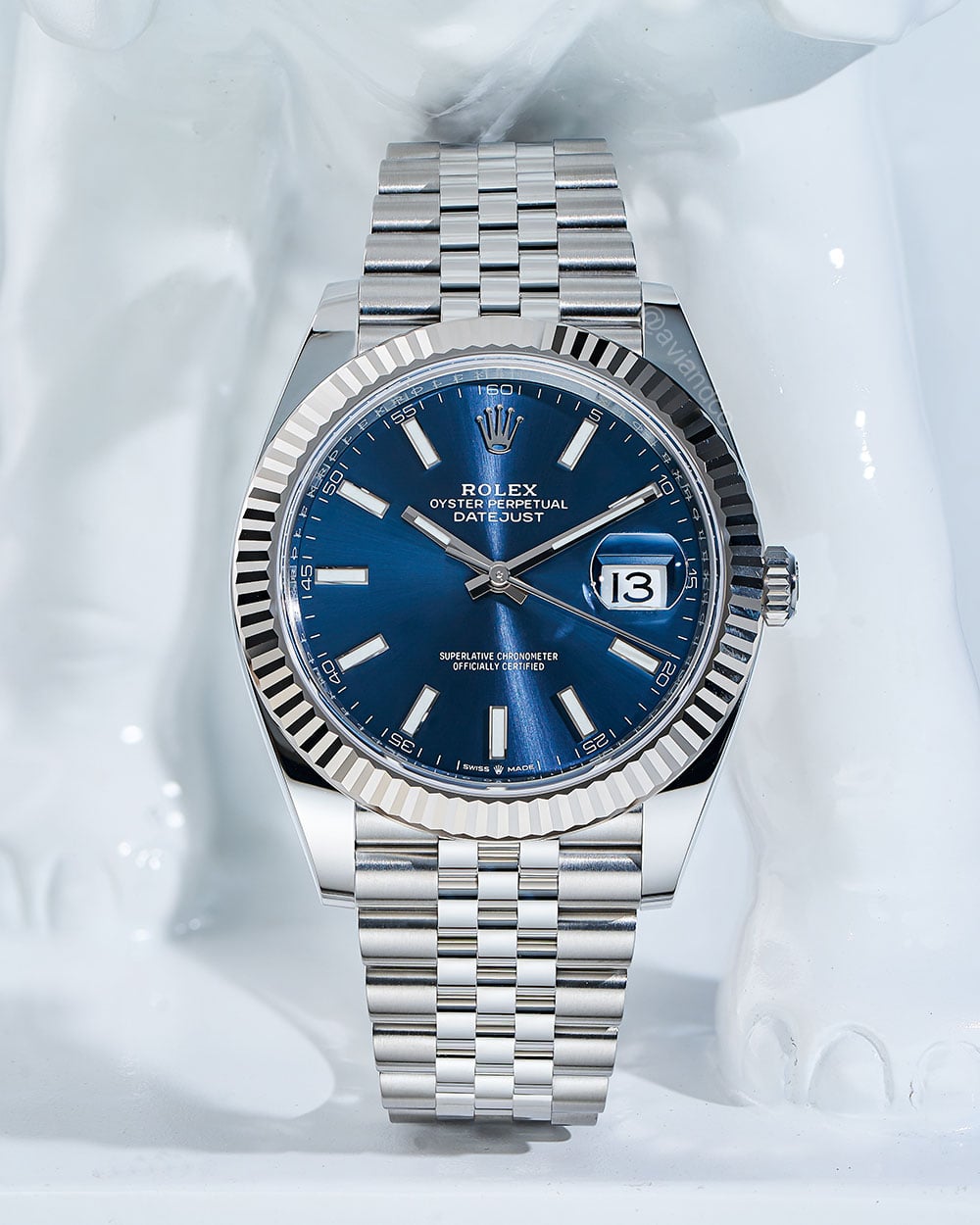
Simple Date: The date complication is the simplest type of calendar complication. You will often see the date (the day of the month) displayed in a window at the 3 o’clock position, as shown on the face of the Rolex Datejust pictured below. Watches with a simple date complication typically have to be adjusted five times per year, because they do not account for the different lengths of the months. Specifically, you will have to adjust the watch at the end of February, April, June, September, and November, as the watch is built to consider each month as 31 days long.
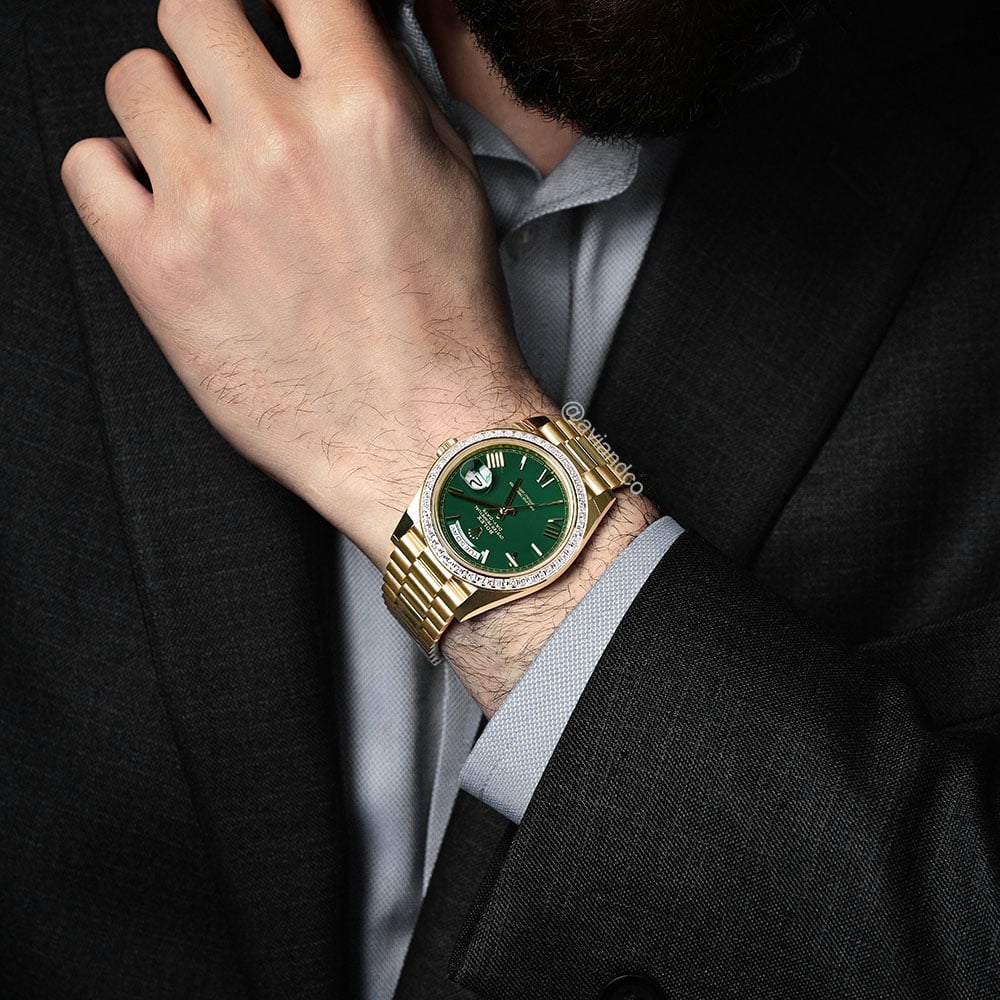
Day-Date: The day-date complication builds on the simple date complication by also showing the day of the week, meaning you get more comprehensive calendar information. The perfect line to showcase this feature? The Rolex Day-Date, of course! You will notice the day of the month shown at the 3 o’clock position as well as the day of the week shown at the 12 o’clock position. Like the simple date complication, you need to adjust these watches five times per year, as they do not account for different lengths of the months.
Annual Calendar: Watches with an annual calendar complication will often show the date, the day of the week, and the month. But what really makes them stand out is that they only need to be adjusted once per year. The annual calendar complication builds on the simpler date and day-date complications to account for months with 30 and 31 days. At the end of each February, a wearer has to adjust the watch to account for its shorter length and leap years. On the Patek Philippe Annual Calendar watch shown below, you can see apertures showing the month and day as well as a date window at the 6 o’clock position.

Perpetual Calendar: Now for the grand finale! The perpetual calendar complication offers all of what you will find in an annual calendar watch, but it takes it to the next level and does not need to be adjusted after the first time you set the date. It accounts for leap years and February’s shorter length, with a “mechanical memory” of 1,461 days (four years) that allows it to stay on track. These timepieces are often whimsically designed and are incredibly complex to create, meaning that they typically have a higher price tag that matches the increased effort.
The Crown Jewel of Complications: The Perpetual Calendar
So, how does the perpetual calendar complication manage to account for leap years? There have been a few different systems designed to tackle this complex function, but generally, a wheel turns one full rotation every four years, driving the calendar indications in relation to each month’s precise length.
Most watches with perpetual calendar complications have separate mechanisms for each component of the calendar (day, date, month, and leap year). These mechanisms are synchronized by a long lever, aptly called the “grand lever,” that runs across the top of the complication and passes through the central axis of the hands. It guides the wheel, which has different ridges and dents to categorize months as having 28, 29, 30, or 31 days. As the date changes, the grand level transmits this information to the relevant components and mechanisms by moving backward and forward. This is a simplification of the incredible technological innovations required to get to this point, but you get a sense of the general idea of how it works.
The first perpetual calendar complication was created by Thomas Mudge, the inventor of the detached level escapement, in 1762. Mudge, however, created this complication for the pocket watch. It was not until 1889, over a century later, that Patek Philippe patented this mechanism for wrist watches.
Watches That Feature Perpetual Calendars
Watchmakers typically reserve their perpetual calendar functions for the most high-end watches in their repertoire. Even the most serious watch collectors might be hard-pressed to find (and afford) a perpetual calendar model. Lucky for you, Avi & Co. has a few difficult-to-find perpetual calendar watches in stock right now, including these heavy hitters.
Patek Philippe Grand Complications
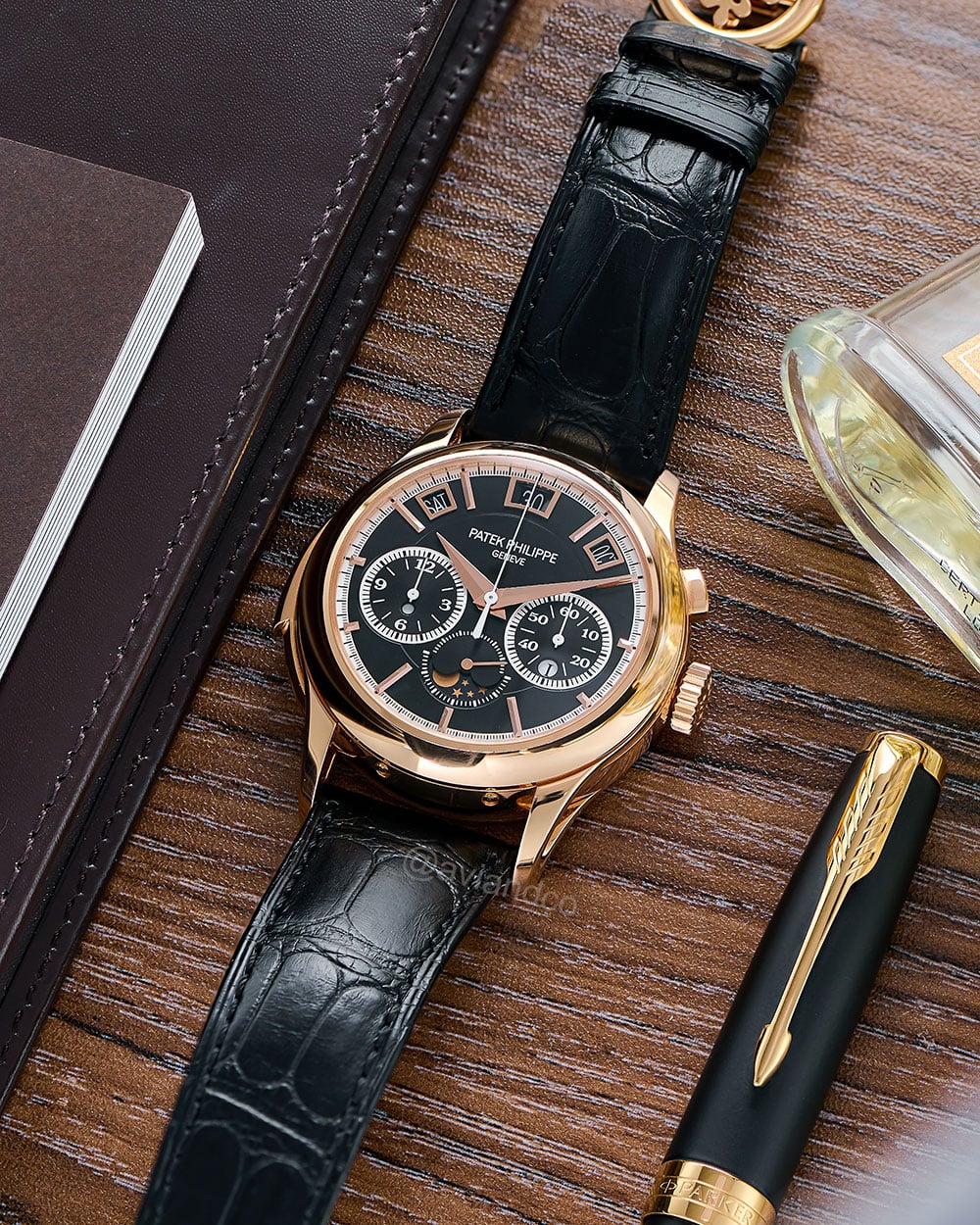
The Grand Complications line is the piece de resistance of Patek Philippe’s repertoire. It showcases the brand’s commitment to incredible mechanical artistry, tradition, and elegance. It is also one of just two Patek Philippe lines where you can find perpetual calendar watches. For instance, this exquisite model offers a perpetual calendar complication for the attractive price of just under $1 million.
We love the striking black dial, which elegantly showcases the calendar elements along the top of its arc. Other high-end features include a monopusher chronograph and a minute repeater. Plus, you will notice a moonphase display at the 6 o’clock position. This rose gold timepiece, complete with a black alligator leather strap, is the perfect example of sophistication, elegance, and timeless style. The Grand Complications line stands on its own for good reason.
Audemars Piguet Royal Oak Perpetual Calendar

Audemars Piguet’s Royal Oak line is perhaps one of the most recognizable collections in modern watchmaking, and its octagonal bezel and exposed screws offer a distinctive and memorable look. Not all Royal Oak watches have a perpetual calendar complication, but the brand has made a select few models that show off this highly desirable feature.
The black ceramic watch above uses dials to show the day of the week (at 9 o’clock), the date (at 3 o’clock), and the month (at 12 o’clock). At 6 o’clock, you will see a moon phase display. The ceramic construction ensured this watch remains durable yet light, and the 41 mm size gives it a versatile and sporty aesthetic. This bold, refined style is a must-have for anyone who loves Audemars Piguet but has not yet acquired the elite perpetual calendar complication.
Patek Philippe Nautilus Perpetual Calendar

Like the Audemars Piguet Royal Oak watches, the Patek Philippe Nautilus line only has a select few models with the perpetual calendar complication. Specifically, we are talking about the Reference #5740. This model was unveiled at Baselworld in 2018 and was immediately met with excitement and enthusiasm. Though it is one of Patek Philippe’s most expensive models, it is highly coveted in the watch world because of its exceptional complications.
With three subdials, this Nautilus 5740 shows the day of the week, the date, and the month as well as a moon phase display at 6 o’clock (within the date dial). It exemplifies the Swiss brand’s commitment to luxury and precision and is sure to become a staple piece in any collection.
Discover Your New Favorite Complication at Avi & Co.
Are you ready to upgrade your watch collection with a perpetual calendar watch? At Avi & Co., we are a trusted provider of high-end watch brands as well as our very own watch collections, which celebrate style and sparkle. Stop into one of our three boutiques located in New York City, Aspen, and Miami or shop or full inventory online.
Make an appointment to shop with us today!