Haunted houses riddled with ghosts and items moving on their own accord seem plausible, but a haunted clock seems a bit unusual. People have told stories about broken watches or clocks that ticked when someone passed. Whether or not they seem believable, these stories can be comforting and even amusing.
With Halloween right around the corner, there are countless spooky stories and terrifying tales circulating – but the curse of the Prague Orloj, an astronomical clock in Prague’s city center that hails from medieval times, stands out as a staple of haunted horology.
What Is the Prague Orloj?
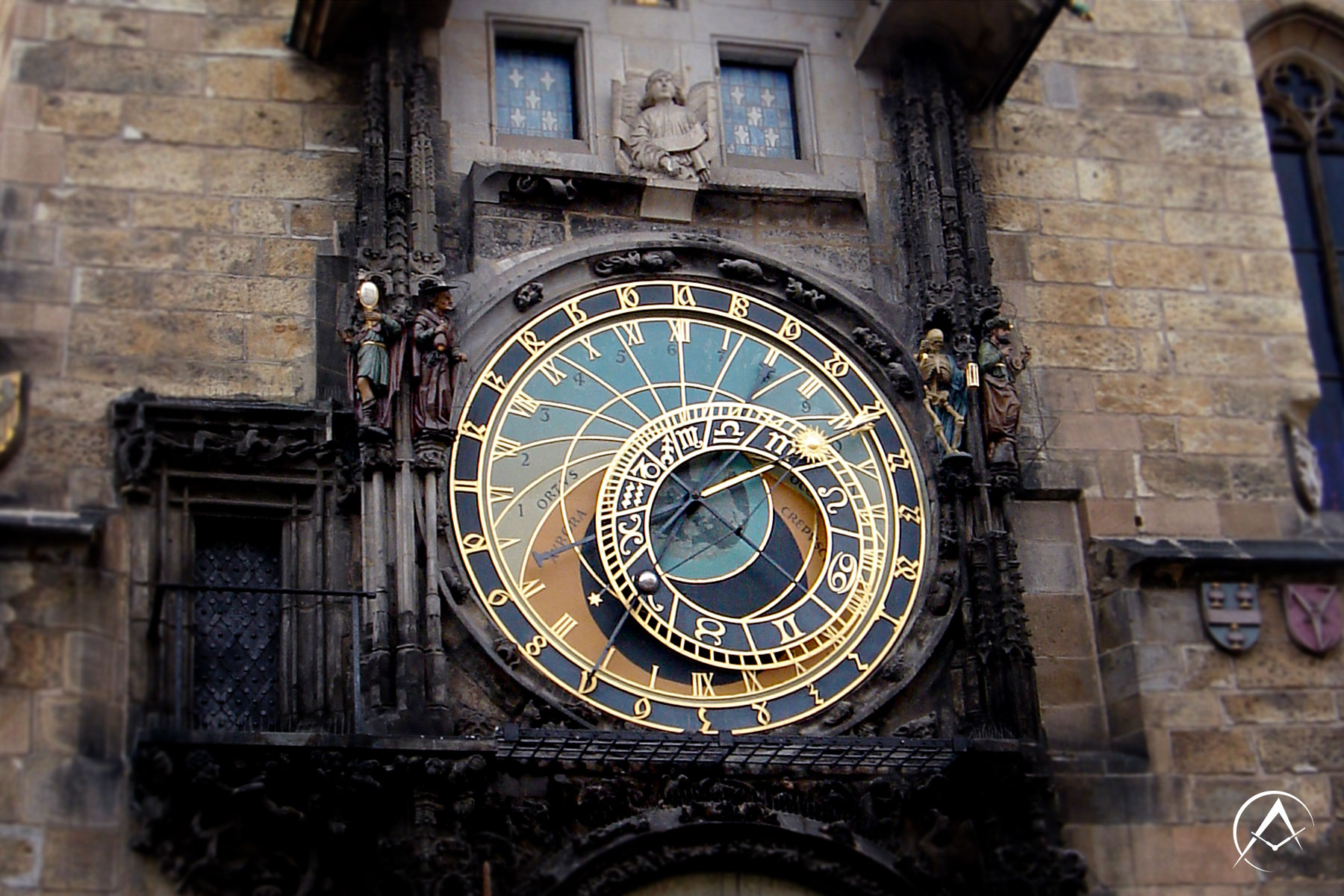
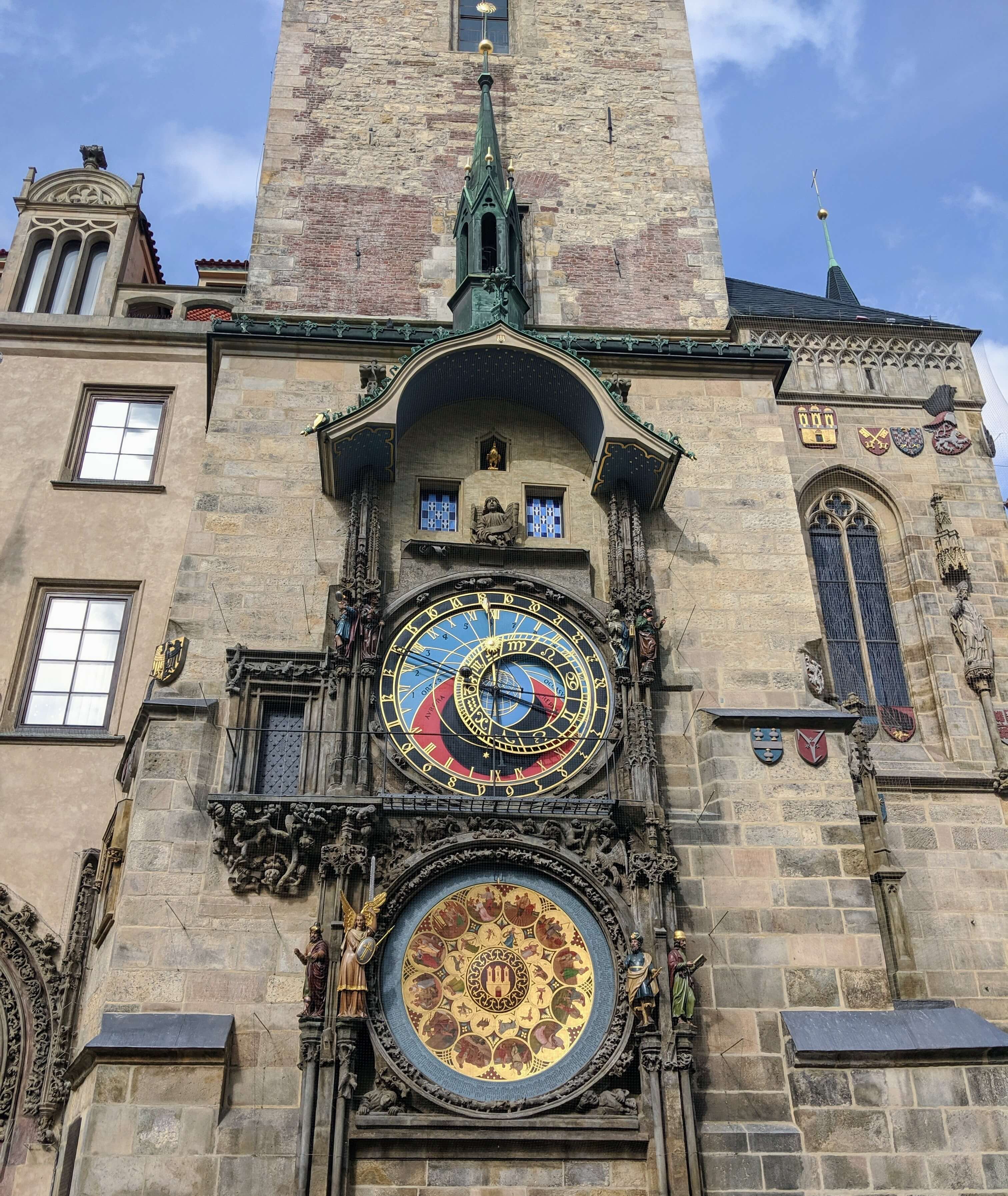
The Prague Astronomical Clock, also known as the Orloj, stands in the capital of The Czech Republic. While Prague is the perfect city for any architectural buff and bohemian-style lover, the clock is the best-known tourist attraction in the largest city of the Czech Republic. It is the third-oldest astronomical clock in the world and the oldest clock still in operation.
The Prague Astronomical Clock
The medieval device, covered with Gothic-style details, is famous for its two intricate astronomical and calendar dials. Additionally, it has gained fame for its massive size, measuring approximately 9.8 feet in diameter. The crowds are known to gather every hour near the south wall of the Old Town Hall in the Old Town Square to see the clock’s animated figures.
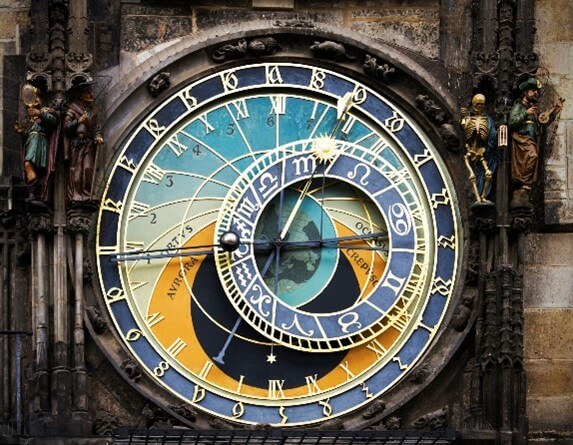
The astronomical dial is a form of mechanical astrolabe, a device used in medieval astronomy. The blue and orange background trimmed with gold represents the earth and sky at different times of the day.
Designed before people knew that it was the Earth that rotates around the sun rather than the other way around, the four phases of the day have the Earth surrounded by orange, black, green, and blue colors. Now, people consider the Orloj a medieval planetarium because it accurately displays the current state of the universe.
Top dial of the Prague Orloj
The Prague Orloj's four moving parts make it a marvel of mechanical engineering. The outer rotating ring displays Babylonian time, Old Bohemian time, German time, and Sidereal time. The inner ring displays the current signs of the zodiac.
In addition, there is a sun hand and a moon hand. The sun hand shows the position of the sun on the ecliptic, which is the Earth’s orbit around the sun. It also displays the time of the sunrise and sunset. The moon hand exhibits the moon ecliptic, as well as the current phase of the moon.
Located below the clock, the calendar dial displays the day of the month (represented by medallions). In addition, it displays the days of the week and even holidays. Alongside the calendar's dial are statues of four virtues: a chronicler, an angel, an astronomer, and a philosopher. When the clock reaches a new hour, the skeleton rings a bell and inverts his hourglass.
Above the astronomical dial, the 12 Apostles peek through two windows before passing by. Upon completion of their 30-second routine, the golden rooster figurine crows. The clock has been running for over 600 years, and it's one of the world's most fascinating timepieces.
The Creation and The Curse of the Prague Orloj
In the 14th and 15th centuries, King Charles IV had a vision for Prague to be redeveloped as one of Europe’s most beautiful cities. Independent artists left their marks on the city, and they built the Old Town Hall Tower.
Contributing to the redesign of the city were clockmaker Mikuláš of Kadaň and astronomer/scientist Jan Šindel. The councilors of Prague chose them to construct a machine that functioned as more than just a timekeeper. The infamous Prague Clock was completed in 1410.
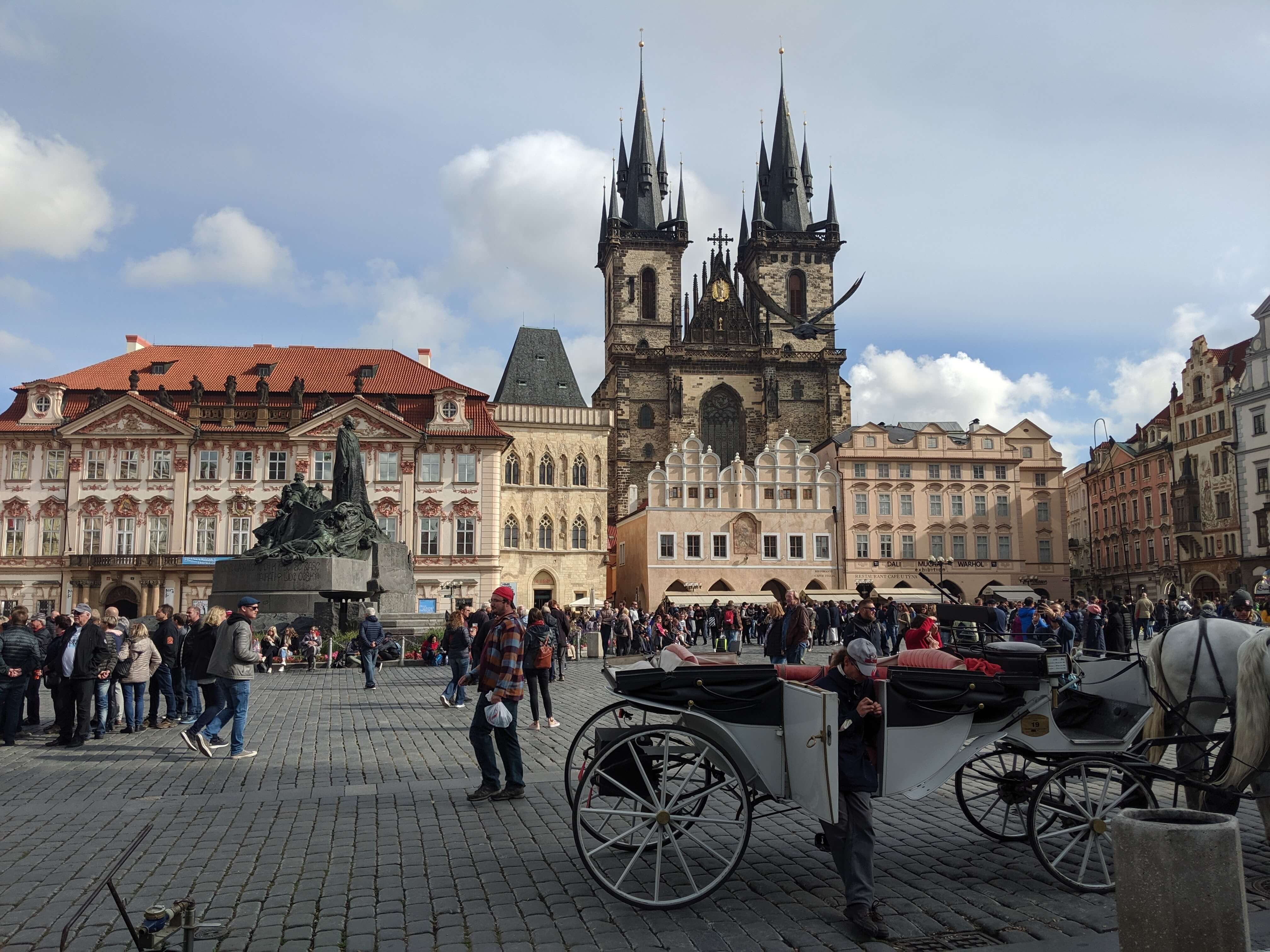
Prague's Old Town Hall
According to medieval legends, Kadaň’s Prague Orloj was considered such a masterpiece that many nations approached him to create an equally magnificent astronomical clock. Jealous and scared that Kadaň would build a bigger and more beautiful clock, the council acted quickly. To ensure no other country would ever have a clock like theirs, they blinded Kadaň with a piece of iron. Enraged, Kadaň sought revenge.
Some stories claim that the clockmaker threw himself into the mechanics of the clock to stop it from ever working. Other stories say he destroyed the mechanism until it was broken beyond repair. Either way, legends agree that whoever attempted to fix the clock would either go insane or die. It took more than a century before another clockmaker found the courage to fix the colossal timepiece once more.
The Restorations of the Prague Orloj
Unafraid of the curse, Jan Růže was commissioned by the Prague City Council to bring the Orloj back to life. He modified the clock by adding the calendar dial, Gothic figurines, and columns in 1490. But he was not the only one who made new-age modifications and additions.
In 1552, clockmaker Jan Táborský spent 20 years repairing the clock and mechanizing the four virtues. Between 1629 and 1659, another artisan added moving wooden figurines.
The four figurines surrounding the clock represented the greatest worries of Prague’s citizens at the time. These were Greed, Vanity, Pagan Invasion, and Death (the skeleton figurine). When the skeleton rings the bell every hour, the other figures shake their heads from side to side, declaring their unreadiness.
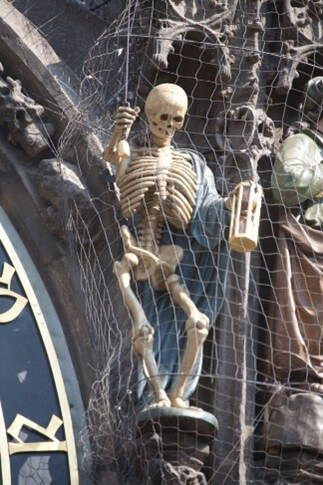
The skeleton figurine on the Prague Orloj
Legend says that whenever the astronomical clock stopped running for an extended period of time, the skeleton would nod his head in confirmation that the Czech nation would suffer bad times until the clock was fixed. In one story, the only way to fend off the impending evil was to wait for the clock to move again and have a boy, born on New Year’s night, run out of the Týn Church across the whole square to the Town Hall before the last strike of the clock.
Most believers of the legend, however, see the skeleton as a sign of hope. Two small windows overlook the clock, and these windows once contained a jail that imprisoned aristocrats. When one knight was pardoned, the people of Prague believed it was due to the skeleton sitting outside the knight’s window.
Between 1787 and 1861, the city of Prague almost sold the clock as scrap metal because they had no money for repairs. Luckily, the “curse” didn’t last long, and restoration began in 1865. This restoration saw the wooden figures within the clock become Apostles. Artisans also added a golden figure of a crowing rooster during the next major repair in 1882. Whistles and bells created the crowing sound.
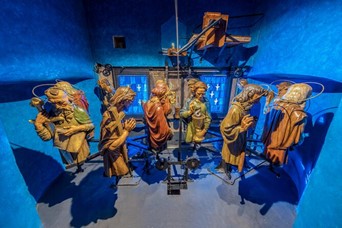
Inside of the Astronomical Clock, you can see the twelve Apostles
True tragedy struck the Prague Clock during the Prague Uprising in May 1945. When the people of the Czech Republic (then Czechoslovakia) rebelled against the seven years of Nazi rule they had endured, the Nazis bombarded the Old Town Hall. The clock suffered severe damage, and fire burned away many of the figures, including the calendar dial. The clock stood motionless for three years until Vojtěch Sucharda repaired the mechanism and the wooden Apostles.
In 1957, artisans added Old Bohemian time to the clock. The Prague City Museum moved the original sculptures to ensure their safety in 1976 and replaced them with copies. The city restored the lower calendar ring in 2005. If you visit the Prague Orloj today, you will see that it is covered by a net to keep pigeons away.
To celebrate the 600th Anniversary anniversary of the clock’s creation, the city put on a light show on the clock face in October 2010. The projectors showcased animated videos of the clock being built, torn down, and rebuilt. They also showed the internal mechanisms, animated figurines, and the clock’s history.
Prague renovated the Old Town Tower in 2018. They replaced the electric clock mechanism from the 1860s with the one that had been functioning since 1948 and restored the clock to its former glory. It is now in full working condition. If you visit the Czech Republic today, do not miss visiting the Prague Orloj! This popular attraction is still standing and attracts many tourists and locals alike to Prague’s Old Town Center.
The Prague Orloj’s Restoration Controversy
In 2022, a local heritage group observed a radical alteration in the reproduction of the Orloj. Some figurines changed in appearance, age, skin tone, and gender. A complaint was registered with the Ministry of Culture alleging that painter Stanislav Jirčík deviated from the original in a 2018 restoration project that cost over 2 million euros.

Details from the astronomical calendar before and after the 2018 restoration
The Prague City Council’s Deputy Mayor for Transport and Heritage suggested the city needed to commission a replacement. As of today, Jirčík’s reasoning for producing these changes remains unknown. He may have studied the original work of Josef Mánes before beginning the restoration. While some believe Jirčík did not have the task of restoring Mánes original work but creating a new rendition, many believe the artist painted his friends into the work as a joke.

Details from the astronomical calendar before and after the 2018 restoration
The Prague Orloj Today
Today, visitors come from far and wide to enjoy the hourly show put on by the Orloj’s wooden figures. You can also enter the Old Town Hall to view the inner mechanics of the Astronomical Clock for a guided tour. For about $10, you will have access to the Old Town Hall and the tower’s observation deck. You can also walk inside each of the halls and the Romanesque underground that used to serve as a jail.
The clock tower, which offers beautiful views of Prague, is open daily until 10 p.m. Aside from tours, the Old Town Hall is primarily used for ceremonies and events.
The Orloj has had many caretakers over the years, ensuring the city of Prague never suffers. For the past ten years, clock master Petr Skala has overseen renovations. He's also in charge of replacing the modern gears with ones that are closer to the original design.
So far, none of the caretakers have died or gone mad because of the clock…at least, none that we know of. Do you believe in the curse of Prague Orloj
Find the Perfect Watch for Spooky Season at Avi & Co.
For those who love horological history and medieval legends like the curse of the Prague Orloj, there is no better investment than a luxury watch imbued with heritage and history. At Avi & Co., that’s exactly what we offer.
We specialize in elite brands like Patek Philippe, Richard Mille, Audemars Piguet, and Rolex. Stop by one of our three locations (we are located in New York City, Miami, and Aspen, Colorado) to explore our storied collections today!
Schedule your appointment right here.