The luxury of the moonphase complication is virtually unparalleled in the world of haute horlogerie. This unique touch is a highly desirable component appearing on only the most elegant high-end watches. We will explain how the moonphase complication works, but perhaps more important is what it signifies: a taste for the finer things in life and an appreciation for the impeccable craftsmanship and artistry behind this unique feature of elite timepieces.
In short, the moonphase complication displays the sunlit portion of the moon as observed from Earth: a waxing crescent, a waning gibbous, a new moon, a full moon, and everything between. The moonphase display on a luxury watch reflects the same moon you would see overhead if you stepped outside at night, offering insight into the natural world with a measure of finesse and complexity that is hard to find elsewhere. It has been around for a while: Patek Philippe introduced the complication to its catalogue in 1925, Rolex introduced the complication in 1949, and Audemars Piguet introduced it in wristwatch form in 1955 (though it had been using it in pocket watches since 1882).
All this is to say that the moonphase complication is the height of elite horological mastery. Taking home a timepiece with a moonphase display is the peak of sophistication and is a must-have in any serious watch collection. Join us as we journey back in time to the very beginnings of the modern moonphase complication. Then, accompany us to the present, where we will share some of our favorite moonphase watches in today’s day and age.
The Development of the Moonphase Complication
People measured time by the rising and setting of the sun before clocks. The changing of the seasons and the phases of the moon also aided humankind in measuring time. Determining the phase of the moon helped sailors navigate the sea by determining the tides.
The Antikythera, an Ancient Greek mechanism from 150 BC, contains one of the oldest watch complications. They created it to show the annual pilgrimage of the sun and moon. The device also predicted the eclipse by mimicking the irregular movement of the moon around the Earth. No one was able to match the complication for nearly 2,000 years.
During the European Renaissance period, people built astronomical clocks into churches and cathedrals to communicate the timing of public events. Built to impress aesthetically as much as to indicate moon phases, these complications showcased a clockmaker’s technical skills. Clocks were used to show that the sun, moon, and planets moved around the Earth. However, scientists then discovered that the Earth is not the center of the universe.
Grandfather clocks built in Germany and England in the 16th century featured the moonphase complication. However, the moonphase function did not appear on a wristwatch until the 20th century. By then, it was no longer a necessity for keeping time.
Types of Moonphase Complications and How They Work
Elegant and artistic, the popular moonphase complication requires numerous calculations. So, how exactly does it work?
Essentially, a system of gears interlocks to match the progression of the moon in a mechanical watch. The gear contains a specific number of teeth, 59 to be exact. This number is not random: It is two times the number of days it takes for the moon to complete one full cycle, 29.5 days.
Every 24 hours, the gear system advances one tooth, moving the display forward. The goal? A rotating moonphase display that will show two full moons, 180 degrees apart. In doing so, this covers two complete moon cycles.
There are four primary lunar cycles: the new moon, the first quarter, the full moon, and the final quarter. In addition, there are four lunar phases: waxing crescent, waxing gibbous, waning gibbous, and waning crescent.
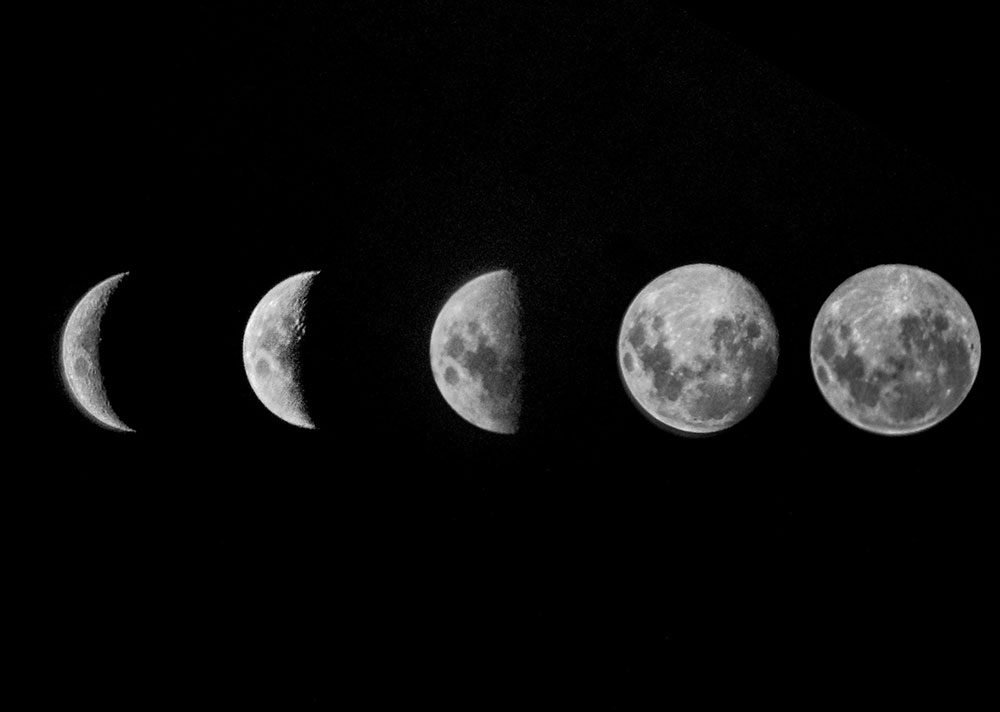
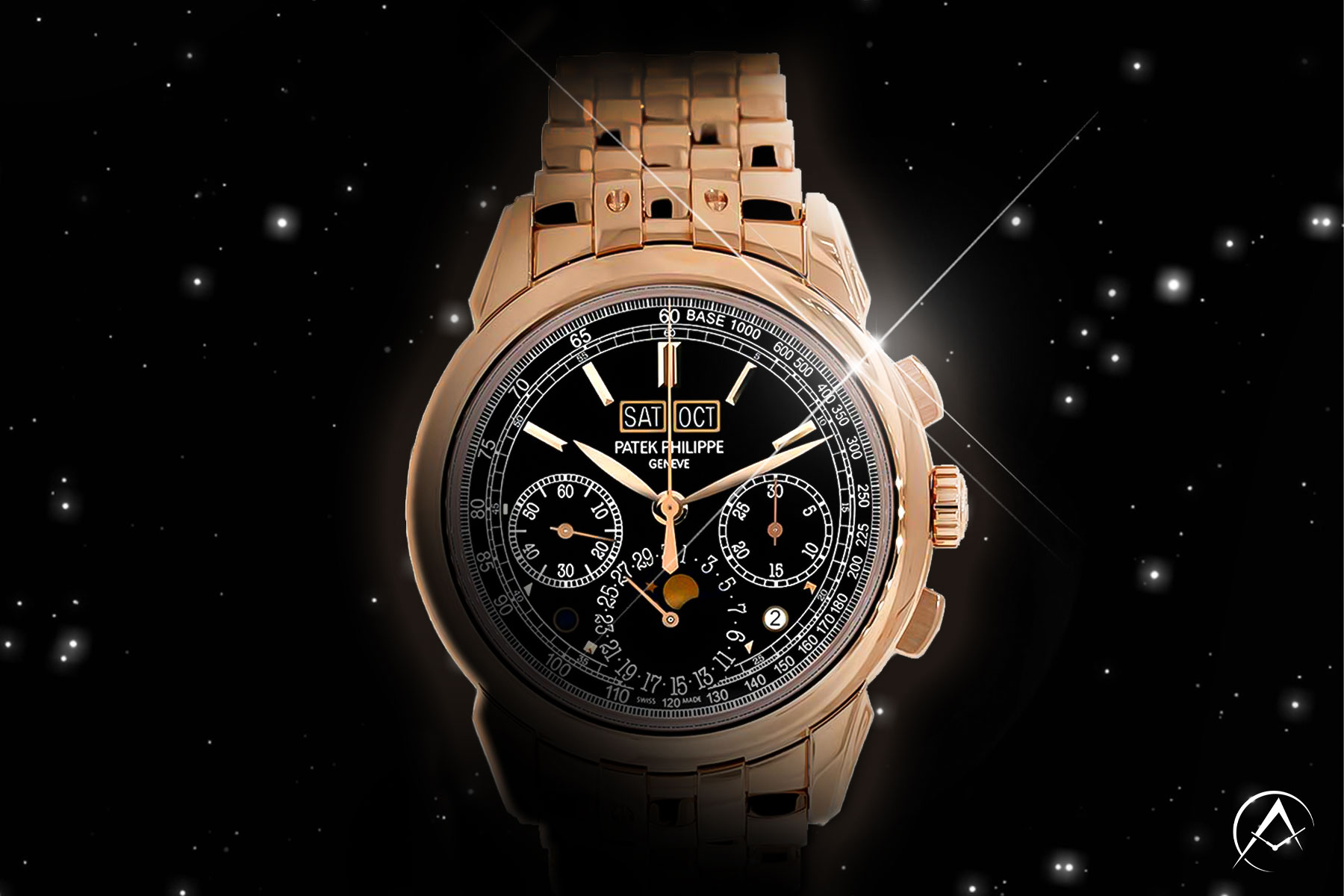
Now, here is where things get interesting. There are two types of moonphase complications in modern watchmaking: radial moonphase and bosom moonphase. The radial complication uses an indicator hand to track the moonphase on a dial. The more eye-catching bosom complication physically shows the moon moving through its various phases using a crescent-shaped aperture.
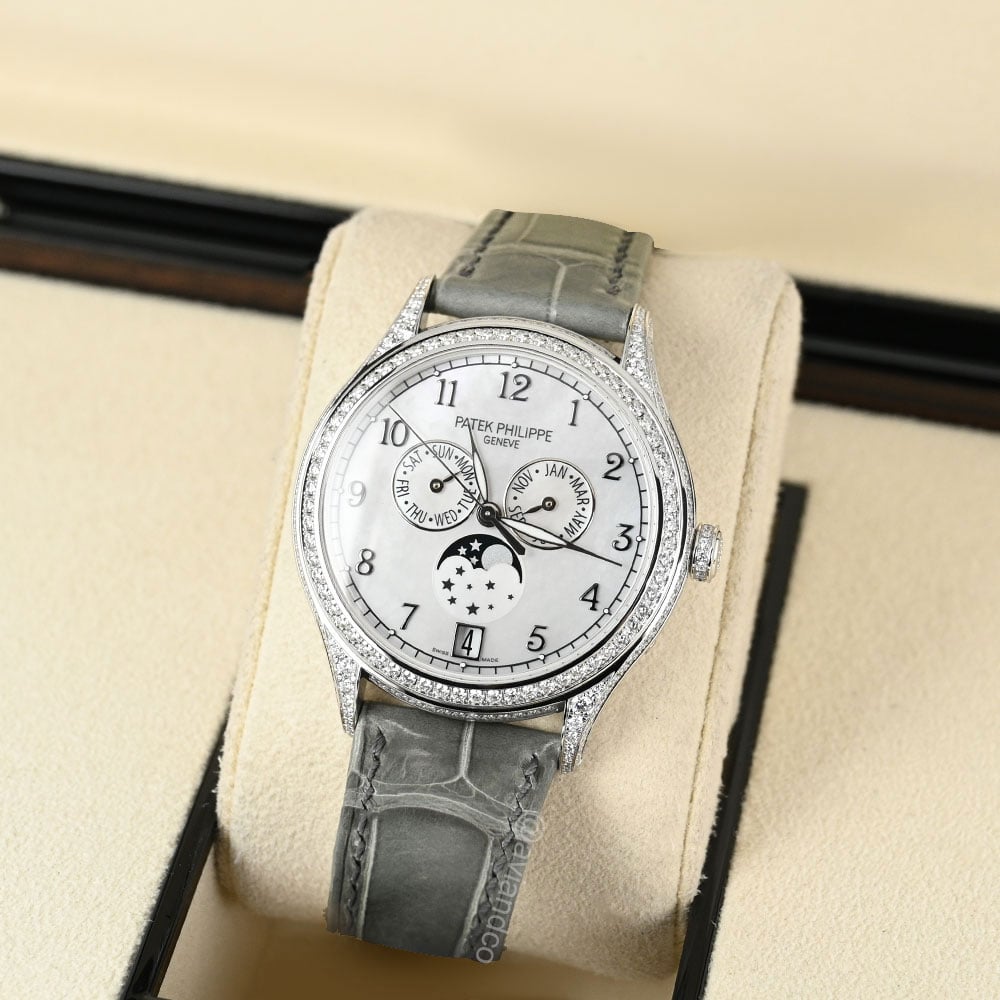
Take a look at the elegant Patek Philippe Complications watch below to better understand the look of the bosom moonphase display. It is shaped like a semicircle, but what would be the flat side of the shape is disrupted by two additional hemispheres. As the moon display rotates behind the bosom cutout, these hemispheres block parts of the moon, showing its phases in a highly legible and visually appealing way.
The Accuracy and Design of the Moonphase Complication
Many timepieces have a moonphase display that requires resetting after about three years to maintain accuracy. However, brands like A. Lange & Sohne and Patek Philippe developed ones that boast over 1,000 years of accuracy. Andreas Strehler, a Swiss watchmaker, received a Guinness World Record in 2014 for developing the 'Sauterelle à lune perpétuélle'. Its moon phase complication will remain accurate for an astonishing two million years.
While some brands strive to make the elegant complication more accurate, others attempt to enhance their design. The dominant aesthetics of watches change over time to keep up with trends. The same could be said about the representation of the moon.
In the 16th and 17th centuries, the moon was cherub-like. This image did not evolve into a man on the moon until the 18th and 19th centuries. The early 20th century saw the moon with an art deco spin, and the later 20th century designed something more minimalistic.
The moon as shown on luxury watches is much more realistic today. Moonphase displays are more often found on high-end timepieces because of the craftsmanship required to construct this movement.
Shop Sophisticated Moonphase Watches at Avi & Co.
Discover modern takes on the moonphase display with our selection of refined timepieces featuring this in-demand complication. The only question left is, which one speaks to your sensibilities. In our opinion, there is no wrong answer here.
Audemars Piguet Royal Oak Perpetual Calendar

In 2015, Audemars Piguet created the Perpetual Calendar Royal Oak. In the decade plus since, this highly complex watch has become a favorite of collectors across the globe. Though the watch retains some classic features of the original Royal Oak line (the octagonal bezel, exposed lugs, and integrated bracelet, to name a few), its dial notably departs from the iconic watch’s traditional minimalism. Here, four subdials display the month, the day of the week, the date, and the moonphase. The 12 o’clock aperture also shows a leap year indicator, a complication Audemars Piguet holds the patent for.
Patek Philippe Nautilus
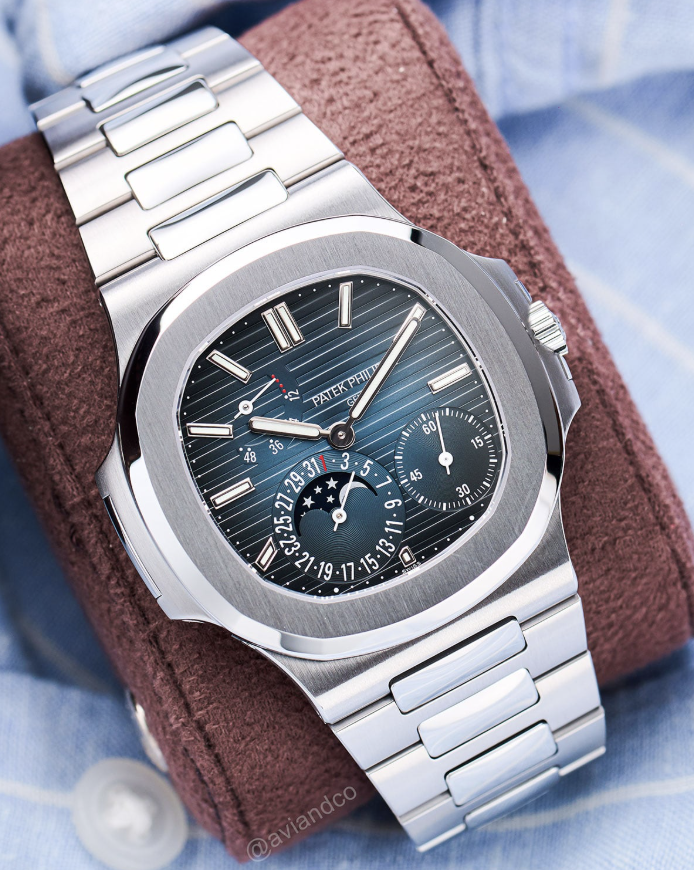
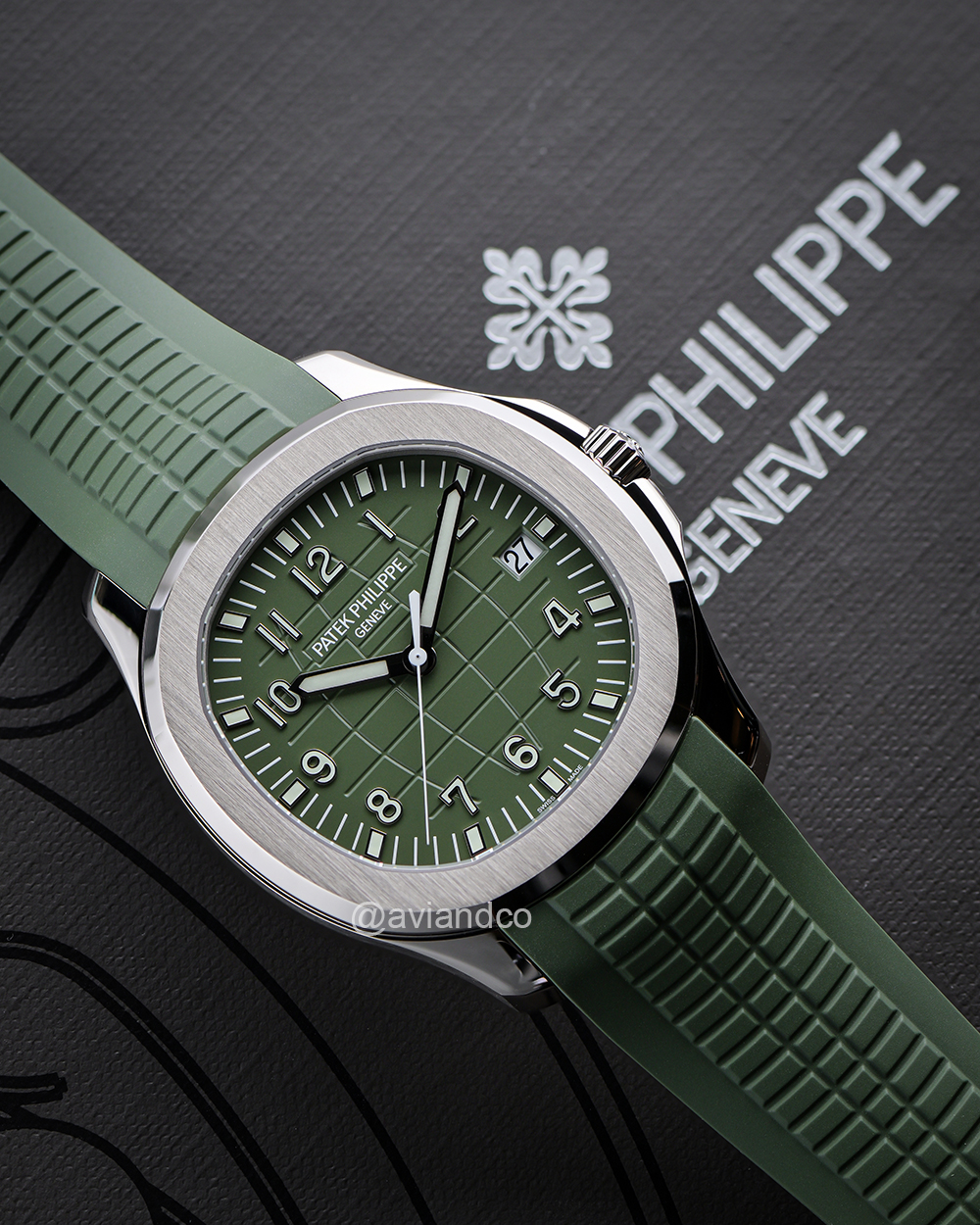
You can keep track of all facets of time when you add a Nautilus moonphase watch to your collection. In this stunning example, the stainless steel 40 mm case is assembled with a fixed, stainless steel bezel, and a screw-down crown. The self-winding 240 PS IRM C LU calibre powers this timepiece, providing a 48-hour power reserve. A favorite among collectors, the Reference 5712 is a memorable and elegant take on the classic Patek Philippe Nautilus line.
Avi & Co. Insights: If you love the refined touch of Patek Philippe watchmaking, be sure to explore the Complications and Grand Complications lines for more moonphase watches.
F.P. Journe Octa Lune

Watchmaker F.P. Journe is a relatively new addition to the horological scene, but his elite timepieces have quickly climbed to the top of the list in terms of desirability. The brand’s motto, invenit et fecit, translates to “invented and made.” In other words, every timepiece from this renowned creator is completely thought up, manufactured, and assembled in house. The craftsmanship and limited numbers of these unique timepieces have rendered them quite difficult to get one’s hands on. Add the moonphase display into the equation, and you have a truly collectible and memorable timepiece.
Celebrities who Love the Moonphase Complication
Watch collectors and A-listers alike love moonphase watches. Here are some of the household names who have called one of these astronomical timepieces their own.
The Ongoing Popularity of the Moonphase Complication
With major advances in technology, it has of course become less common to use the moon as a clock. Despite this, its movement continues to fascinate people. In 2015, a Patek Philippe moonphase watch (Reference #1518) made $11 million at auction. At the time, this was the most expensive watch ever sold.
People appreciate tracking the moon’s movements and enjoy the aesthetic it has on a timepiece. The moon is a romantic and fascinating motif. Even with the knowledge we have, a lot of its secrets remain hidden. The secrets are only visible through reflecting on it through literature, music, and art. And here, of course, in the world of horology.
Find the Timepiece of Your Dreams at Avi & Co.
Here at Avi & Co., we have a broad collection of exquisite timepieces for every consumer. We are a trusted provider of numerous globally renowned luxury watch brands, including Patek Philippe, Rolex, Audemars Piguet, and Richard Mille. We have also launched three of our very own Avi & Co. watch lines and our bespoke Diamonds by Avi & Co. collection, which showcases fine diamond jewelry that is crafted to impress.
Make an appointment to shop in store with us today at any of our three locations. We cannot wait to give you a warm welcome into our Avi & Co. family.