

The Ultimate Patek Philippe Nautilus Reference Guide (2026 Edition)
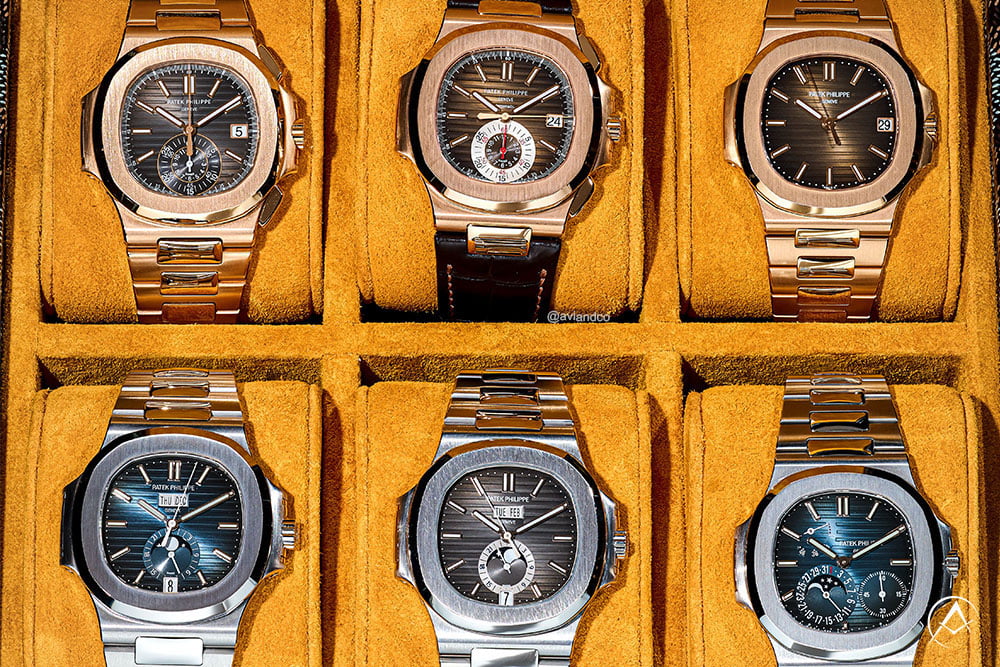
This guide provides a comprehensive reference to the Patek Philippe Nautilus, covering its history, every major reference, technical specifications, movements, production timeline, market values, investment performance, and the questions collectors ask most frequently. Whether you are researching your first Nautilus, comparing individual references, or studying the evolution of one of horology’s most celebrated collections, this encyclopedia is designed to serve as a definitive resource.
What Is the Patek Philippe Nautilus?
The Patek Philippe Nautilus is one of the most influential luxury sports watches ever created. Introduced in 1976 and designed by legendary watch designer Gérald Genta, the Nautilus challenged traditional ideas of luxury watchmaking by combining a stainless steel case, integrated bracelet, and sophisticated finishing with the craftsmanship and prestige for which Patek Philippe was already renowned. Nearly five decades later, it remains one of the world’s most desirable timepieces, representing the intersection of exceptional engineering, timeless design, and enduring collector demand.
Originally launched as the Reference 3700/1A, the Nautilus arrived during a period of significant change for the Swiss watch industry. The Quartz Crisis had disrupted the traditional mechanical watch market, forcing prestigious manufacturers to rethink their product offerings. Rather than competing on affordability, Patek Philippe introduced an entirely new category: a luxury sports watch that commanded a premium price despite being crafted primarily from stainless steel. This bold strategy proved transformative, helping redefine what collectors expected from a high-end wristwatch.
Designed by Gérald Genta, who also created the Audemars Piguet Royal Oak, the Nautilus drew inspiration from the rounded portholes found on transatlantic ocean liners. Its distinctive octagonal bezel with softly rounded edges, horizontally embossed dial, and seamlessly integrated bracelet created a silhouette unlike any other watch of its era. While the design was initially polarizing, it has since become one of the most recognizable watch designs ever produced and serves as the foundation for nearly every modern integrated-bracelet luxury sports watch.
Today, the Nautilus collection extends far beyond the original time-only model. Modern references include annual calendars, chronographs, travel-time complications, perpetual calendars, moon phases, and gem-set editions crafted in stainless steel, white gold, rose gold, yellow gold, and platinum. Despite this evolution, every Nautilus retains the defining design language established by the original 1976 reference, demonstrating the remarkable longevity of Genta’s vision.
The Nautilus is also one of the strongest-performing luxury watches on the secondary market. Many references, particularly discontinued models such as the Reference 5711, have appreciated significantly beyond their original retail prices, fueled by limited production, extensive waiting lists, and sustained global demand. While market values fluctuate over time, the Nautilus consistently ranks among the most collectible watches produced by any manufacturer.
More than a successful product line, the Nautilus represents a turning point in modern horology. Its introduction reshaped the perception of luxury sports watches, influenced generations of watch designers, and helped establish integrated-bracelet sports watches as one of the defining categories of contemporary watchmaking. Alongside icons such as the Audemars Piguet Royal Oak and the Vacheron Constantin Overseas, the Nautilus occupies a permanent place in the history of Swiss watchmaking.
Patek Philippe Nautilus at a Glance
| Attribute | Details |
| Introduced | 1976 |
| Designer | Gérald Genta |
| First Reference | 3700/1A |
| Manufacturer | Patek Philippe |
| Watch Type | Luxury sports watch |
| Signature Features | Integrated bracelet, porthole-inspired bezel, horizontally embossed dial |
| Currently Produced | Yes |
| Most Famous References | 3700, 5711, 5712, 5980, 5740, 5811 |
History of the Patek Philippe Nautilus
The Birth of a Modern Icon
The history of the Patek Philippe Nautilus begins long before the watch itself was introduced. To understand why the Nautilus became one of the most important luxury watches ever created, it is necessary to understand the state of the Swiss watch industry during the early 1970s.
For much of the twentieth century, luxury watchmaking followed a well-established formula. Dress watches dominated the market, precious metals symbolized prestige, and stainless steel was largely reserved for professional tool watches intended for divers, pilots, or military personnel. High-end Swiss manufacturers, including Patek Philippe, built their reputations on elegant gold watches featuring slim profiles, understated aesthetics, and exceptional mechanical movements. By the late 1960s and early 1970s, however, that traditional model faced an unprecedented challenge.
The Quartz Crisis Changes Everything
The emergence of quartz technology fundamentally altered the global watch industry. Japanese manufacturers, led by Seiko, introduced highly accurate quartz watches. Consumers quickly embraced this new technology. Throughout the 1970s, demand for mechanical watches declined sharply as affordable quartz watches became widely available around the world.
This period, now commonly known as the Quartz Crisis, proved devastating for the Swiss watch industry. Hundreds of manufacturers either closed their doors, merged with competitors, or significantly reduced production. Employment within the Swiss watch sector declined dramatically as companies struggled to adapt to changing consumer preferences.
Unlike many manufacturers, however, Patek Philippe refused to concede on price or mass production. Instead, the company doubled down on craftsmanship, exclusivity, and mechanical excellence. Rather than attempting to produce inexpensive quartz watches, Patek Philippe sought a completely new way to demonstrate the value of traditional Swiss watchmaking.
The Rise of the Luxury Sports Watch
Around the same time, consumer tastes were beginning to evolve. Affluent buyers increasingly wanted watches that could transition effortlessly between business meetings, travel, leisure, and formal occasions. Rather than owning separate watches for different activities, collectors began looking for versatile timepieces that combined durability with refined finishing.
The idea of an expensive sports watch made from stainless steel was still controversial. At the time, steel was viewed as a practical material rather than a luxurious one. Gold remained the standard for prestige; steel watches were more commonly associated with professional use rather than haute horlogerie.
Everything changed in 1972, when Audemars Piguet introduced the Royal Oak. Designed by Gérald Genta (yes, the same one), the Royal Oak demonstrated that collectors would pay a premium for a meticulously finished stainless steel sports watch featuring an integrated bracelet and distinctive case design. Although its initial reception was mixed, the Royal Oak gradually established an entirely new category within luxury watchmaking.
They would not be alone in that category. Patek Philippe recognized the potential of this emerging market and soon began developing its own interpretation of the luxury sports watch.
Gérald Genta and the Design of the Nautilus
Few individuals have influenced modern watch design more profoundly than Gérald Genta. By the mid-1970s, Genta had already established himself as one of the industry’s most respected designers. His ability to combine technical functionality with bold aesthetics had earned him commissions from many of Switzerland’s most prestigious manufacturers.
According to the widely accepted account, Genta conceived the initial concept for the Nautilus while dining at the Basel Watch Fair in the mid-1970s, seated near executives from Patek Philippe. Genta reportedly sketched the outline of the watch on a paper napkin in just a few minutes. Whether or not some details of that story have become embellished over time, there is little debate about the originality of the resulting design.
Instead of creating another conventional circular sports watch, Genta drew inspiration from the rounded portholes found on ocean liners. This influence can be seen throughout the Nautilus, including its rounded octagonal bezel (also called “cushion-shaped”), prominent side hinges resembling porthole fasteners, and integrated bracelet that flows naturally from the case.
The result was a watch that felt simultaneously elegant, industrial, and unmistakably modern. Now, over fifty years later, the silhouette of the Nautilus watch remains instantly recognizable.
The Introduction of the Reference 3700
Patek Philippe officially introduced the Nautilus in 1976 with the launch of the Reference 3700/1A.
The watch immediately stood out from the company’s previous creations. First and foremost, it measured approximately 42 mm across the case, an unusually large size for the era that earned it the nickname "Jumbo." At a time when many men’s watches measured between 34 and 36 millimeters, the Nautilus appeared remarkably bold.
Equally surprising was its construction. The case was crafted from stainless steel rather than precious metal, yet it carried a price comparable to many gold dress watches. Its integrated bracelet featured exceptional hand-finishing, alternating brushed and polished surfaces. This was a level of craftsmanship rarely seen on steel sports watches.
The watch housed the ultra-thin Caliber 28-255 C, a movement derived from the renowned Jaeger-LeCoultre Caliber 920. This movement allowed the Nautilus to maintain an impressively slim profile despite its robust appearance. It had a total thickness of just 7.6 millimeters.
The horizontally embossed blue dial, luminous baton markers, and clean date display at three o’clock completed a design that has remained remarkably consistent over the years.
Early Reception
Contrary to popular belief, the Nautilus was not an immediate commercial success. Its unconventional appearance, large dimensions, and premium price confused many traditional collectors. Some questioned why anyone would pay luxury-watch prices for a stainless steel sports watch when precious-metal dress watches had long represented the pinnacle of prestige.
Patek Philippe itself recognized the challenge. One of the brand’s most famous advertisements described the Nautilus with the headline: "One of the world’s costliest watches is made of steel."
Rather than apologizing for the material, the campaign emphasized the extraordinary craftsmanship required to manufacture the watch, reinforcing the idea that luxury was defined by execution rather than by precious metals alone.
The Evolution of the Collection
Throughout the 1980s and 1990s, Patek Philippe steadily expanded the Nautilus collection. The company introduced smaller case sizes to appeal to a broader audience. Additional references incorporated precious metals, two-tone construction, and more sophisticated complications.
The collection evolved without abandoning the design principles established by the original Reference 3700. Unlike many luxury watch lines that undergo dramatic stylistic changes over time, every generation of the Nautilus remained unmistakably connected to its predecessor.
This continuity has become one of the collection’s defining strengths. Collectors can trace a clear visual lineage from the original 3700 to contemporary references such as the 5811, despite nearly five decades of technological advancement.
The Modern Nautilus Era
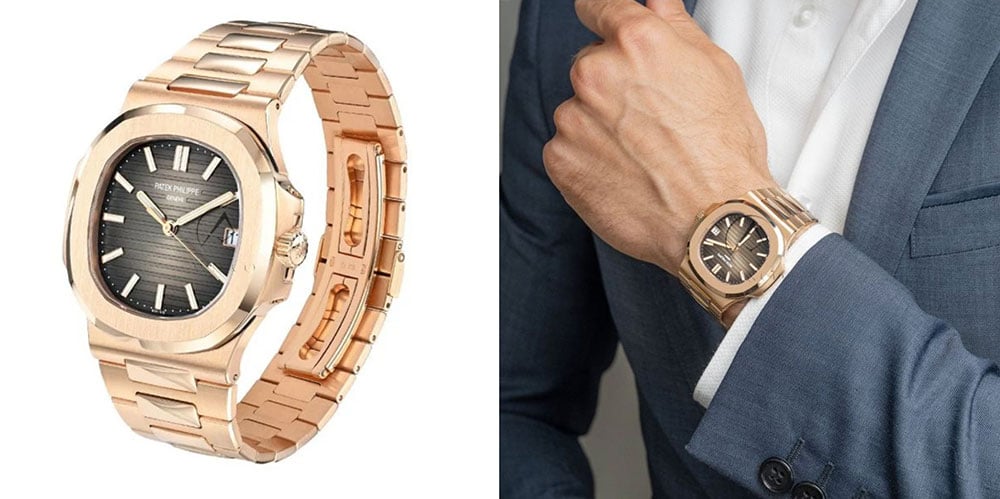
Patek Philippe Nautilus Reference 5711
The introduction of the Reference 5711 in 2006 marked perhaps the most significant milestone in the collection’s modern history. The 5711 was released to celebrate the Nautilus’s 30th anniversary. It refined the original formula with a slightly larger case, an updated in-house movement, improved bracelet construction, and subtle aesthetic refinements while preserving the proportions that made the 3700 so iconic.
By the late 2010s, waiting lists stretched for years, and secondary-market prices routinely exceeded retail by substantial margins. The Nautilus became one of the world’s most sought-after luxury watches, driven by limited production, celebrity visibility, and growing global interest in collectible timepieces.
The surprise discontinuation of the Reference 5711 in 2021 further intensified collector demand, cementing its status as one of the defining watches of the modern era. Its successor, the Reference 5811, was introduced in 2022 and continued the evolution of the original design while incorporating updated proportions and technical refinements.
A Lasting Legacy
Today, the Patek Philippe Nautilus is widely regarded as one of the most influential wristwatches ever produced. Its success permanently changed the perception of luxury sports watches, proving that exceptional design, meticulous finishing, and mechanical excellence could elevate stainless steel to the highest levels of haute horlogerie.
More importantly, the Nautilus established a design language that has remained relevant for nearly half a century. While countless watches have attempted to emulate its integrated bracelet, balanced proportions, and refined sport-luxury aesthetic, few have achieved the same combination of technical sophistication, cultural significance, and enduring desirability.
From the revolutionary Reference 3700 to the contemporary 5811 and the highly complicated models that now define the collection, the Nautilus continues to embody Patek Philippe’s philosophy of timeless design and uncompromising craftsmanship. Its story is not simply the history of a single watch collection. It is the story of how one bold idea transformed the future of luxury watchmaking.
Every Major Patek Philippe Nautilus Reference
Since its debut in 1976, the Patek Philippe Nautilus has evolved from a single stainless steel sports watch into one of the most diverse and technically sophisticated collections in haute horlogerie. While dozens of Nautilus references have been produced over the past five decades (including precious metal editions, gem-set models, ladies’ references, and highly complicated watches) a relatively small number of references define the collection’s history and have had the greatest impact on collectors.
The watches below represent the most important milestones in the evolution of the Nautilus. Together, they illustrate how Patek Philippe has refined Gérald Genta’s original design while preserving the characteristics that have made the Nautilus one of the most recognizable and sought-after luxury watches in the world.
Patek Philippe Nautilus Reference 3700/1A (1976–1990)
Overview
The Reference 3700/1A is the watch that started it all. Introduced in 1976, it established the blueprint for every Nautilus that followed and remains one of the most historically significant luxury sports watches ever produced.
Unlike traditional luxury watches of the period, the 3700 featured a stainless steel case and integrated bracelet with meticulous hand-finishing. It demonstrated that craftsmanship, not precious metals alone, could define luxury.
Powered by the ultra-thin Caliber 28-255 C, based on the legendary Jaeger-LeCoultre 920 architecture, the watch combined elegance with remarkable technical sophistication. Its two-piece monobloc case construction also contributed to its distinctive profile and helped achieve water resistance without sacrificing slimness.
Today, collectors regard the 3700 as one of the most important vintage Patek Philippe watches ever produced.
Why Collectors Love It
- The original Nautilus
- Designed by Gérald Genta
- Historically significant
- Exceptionally thin
- Long production run with several dial and bracelet variations
- Increasingly difficult to find in original condition
| Specification | Details |
| Production Years | 1976–1990 |
| Diameter | 42 mm (“Jumbo”) |
| Movement | Caliber 28-255 C |
| Functions | Hours, Minutes, Date |
| Water Resistance | 120 meters |
| Case Material | Stainless steel (primarily) |
| Current Market | Highly collectible |
Patek Philippe Nautilus Reference 3800 (1981–2006)
Introduced in 1981, the Reference 3800 expanded the Nautilus collection by offering a more versatile size. Measuring approximately 37.5 mm, it appealed to collectors who admired the original design but preferred more traditional proportions.
Unlike the 3700, the 3800 featured a center second hand and utilized Patek Philippe’s Caliber 335 SC, marking an important technical evolution for the collection. Over its lengthy production run, the 3800 was offered in stainless steel, yellow gold, two-tone, white gold, and rose gold, with numerous dial variations that make the reference particularly interesting for collectors.
Many enthusiasts consider the 3800 one of the most underrated Nautilus references, because it combines vintage charm with everyday wearability.
| Specification | Details |
| Production Years | 1981–2006 |
| Diameter | 37.5 mm |
| Movement | Caliber 335 SC |
| Notable Feature | First Nautilus with center seconds |
Patek Philippe Nautilus Reference 3710 (1998–2006)
The Reference 3710 marked one of the first significant departures from the original time-and-date Nautilus formula.
Featuring a power reserve indicator positioned between 10 and 11 o’clock alongside Roman numeral hour markers, the 3710 introduced greater visual complexity while maintaining the recognizable Nautilus silhouette. Though its asymmetrical dial layout divided collectors when it was introduced, it ultimately developed a loyal following for its appearance and relative rarity.
Patek Philippe Nautilus Reference 3711 (2004–2006)
Produced for only a short period, the Reference 3711 represented an important milestone as the first full-sized Nautilus crafted entirely in white gold. Although visually similar to the original Jumbo, the precious metal construction gave the watch greater wrist presence while preserving the understated elegance of the Nautilus design. Its limited production has made it one of the more desirable transitional references among collectors.
Patek Philippe Nautilus Reference 3712 (2005–2006)
Despite being produced for only about one year, the Reference 3712 has become one of the most beloved Nautilus references ever made. Its beautifully balanced asymmetrical dial combines a moon phase, power reserve indicator, small seconds, and date display without feeling cluttered.
Many collectors consider the 3712 one of the finest expressions of complicated Nautilus design. Its current successor is the Reference 5712.
Patek Philippe Nautilus Reference 5711 (2006–2021)
Arguably, no Nautilus reference has had a greater influence on the modern watch market than the Reference 5711.
Released to celebrate the collection’s 30th anniversary, the 5711 refined the proportions of the original Jumbo while introducing Patek Philippe’s in-house Caliber 324 SC. Demand steadily increased throughout its production until waiting lists stretched for years and secondary-market prices reached several multiples of retail.
Its discontinuation in 2021 instantly transformed it into one of the defining collector watches of the twenty-first century. Certain 5711 variations, including the famous >Tiffany blue dial, have attracted even more attention from celebrities and high-end collectors alike.
Patek Philippe Nautilus Reference 5712 (2006–Present)
The Reference 5712 expanded upon the short-lived 3712 while becoming one of the collection’s most distinctive references.
Its asymmetrical arrangement of the moon phase, date, power reserve, and small seconds creates a layout unlike any other luxury sports watch. Collectors often describe the 5712 as offering the perfect balance between everyday wearability and sophisticated complications.
Patek Philippe Nautilus Reference 5726 (2010–Present)
The Patek Philippe Nautilus 5726 introduced the Annual Calendar complication to the Nautilus collection. Available on both leather straps and integrated bracelets, it combines day, date, month, moon phase, and 24-hour indication while maintaining exceptional everyday usability.
It is frequently recommended as one of the best values among complicated Nautilus references and is popular among those who like the Nautilus look but desire more complications than the classic minimalist dials offer.
Patek Philippe Nautilus Reference 5740 (2018–Present)
The Patek Philippe Nautilus 5740 represents the pinnacle of regular-production Nautilus complications. Powered by the ultra-thin Caliber 240 Q, it offers a perpetual calendar within the elegant proportions of the Nautilus case. Patek Philippe accomplished this without significantly increasing case thickness, preserving one of the defining characteristics of the collection.
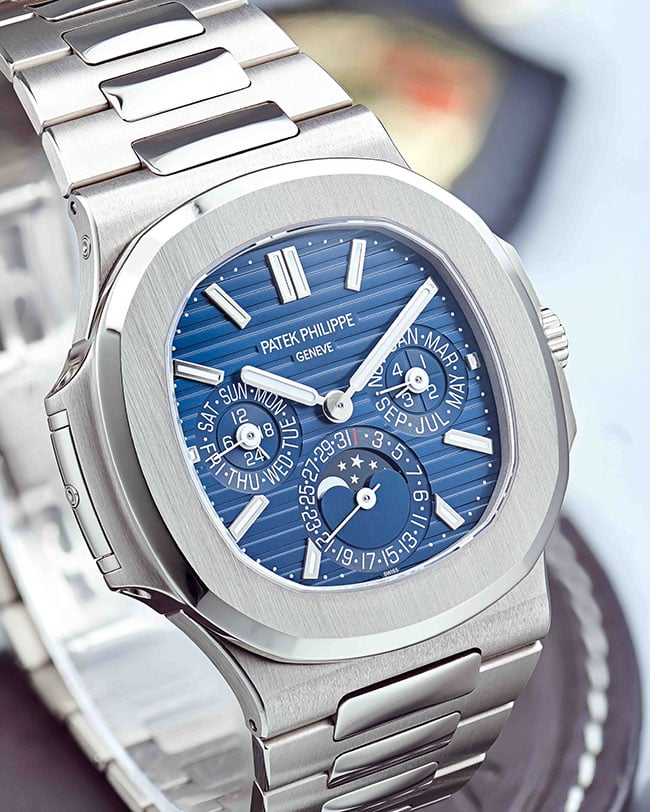
Patek Philippe Nautilus 5740 Perpetual Calendar
Patek Philippe Nautilus Reference 5980 (2006–Present)
The Reference 5980 brought the chronograph function to the Nautilus line. Its patented chronograph movement, integrated flyback functionality, and distinctive monocounter layout created one of the most technically advanced sports chronographs in modern luxury watchmaking.
Patek Philippe Nautilus Reference 5990 (2014–Present)
The Reference 5990 combines a flyback chronograph with travel time functionality, making it one of the most practical Nautilus references for frequent travelers. Its combination of complications demonstrates Patek Philippe’s ability to integrate sophisticated mechanical engineering without compromising legibility.
Patek Philippe Nautilus Reference 5811 (2022–Present)
Following the discontinuation of the legendary 5711, Patek Philippe introduced the Reference 5811 as its spiritual successor. Slightly larger (41 mm) and crafted exclusively in white gold, this reference incorporates subtle case refinements, an updated clasp, and enhanced movement architecture while remaining unmistakably faithful to Gérald Genta’s original vision.
Rather than reinventing the Nautilus, the 5811 demonstrates Patek Philippe’s philosophy of continuous refinement.
Evolution and Production Timeline of the Patek Philippe Nautilus
The success of the Patek Philippe Nautilus cannot be attributed to a single watch. Instead, it is the result of nearly five decades of careful evolution. Unlike many luxury watch collections that undergo dramatic redesigns every few years, the Nautilus has remained remarkably faithful to Gérald Genta’s original vision while continuously incorporating new movements, complications, materials, and manufacturing techniques.
This philosophy of gradual refinement has become one of the defining characteristics of the collection. Every new Nautilus reference builds upon the foundation established by the original Reference 3700, ensuring that a modern Nautilus remains immediately recognizable despite significant technical advancements over the past fifty years.
Rather than chasing short-lived design trends, Patek Philippe has consistently prioritized timeless aesthetics, mechanical innovation, and long-term collectability. As a result, each generation of the Nautilus tells an important chapter in the story of modern luxury watchmaking.
1976: The Beginning of the Nautilus
The introduction of the Reference 3700/1A in 1976 marked one of the most important moments in Patek Philippe’s history. Designed by Gérald Genta, the watch introduced a bold new concept: a luxury sports watch crafted primarily from stainless steel, featuring an integrated bracelet, exceptional finishing, and a price that rivaled many gold dress watches.
The design challenged nearly every convention of luxury watchmaking at the time. Although its reception was initially mixed, the Reference 3700 ultimately laid the foundation for one of the most successful collections in Swiss watchmaking.
1981–1990: Expanding the Collection
As collector interest grew, Patek Philippe began expanding the Nautilus family beyond the original model. The introduction of the Reference 3800 in 1981 offered a more traditionally sized alternative and added a central seconds hand. Throughout the 1980s, the collection expanded to include smaller case sizes, precious metal models, and two-tone variations, making the Nautilus accessible to a broad range of collectors without sacrificing its identity.
These early years established the Nautilus as a permanent part of the Patek Philippe catalog rather than a one-time design experiment.
Late 1990s–Early 2000s: Mechanical Sophistication
By the late 1990s, the Nautilus had matured into a platform capable of showcasing increasingly sophisticated complications. References such as the 3710 introduced a power reserve indicator, while the short-lived 3712 demonstrated that moon phases, small seconds, and power reserve displays could be integrated into the Nautilus without disrupting the balance of its iconic design.
These watches marked the beginning of the Nautilus’s transformation from a simple luxury sports watch into a complete high-complication collection. Furthermore, the 1990s brought the launch of the Patek Philippe Aquanaut, the sporty sister line of the Nautilus. This evidenced Patek Philippe’s ability to innovate on the classic yet also signaled the brand’s commitment to preserving the integrity of the Nautilus line itself.
2006: A New Generation Begins
The year 2006 represents perhaps the most significant turning point in the history of the Nautilus since its original launch. To celebrate the collection’s 30th anniversary, Patek Philippe introduced the Reference 5711. Rather than redesigning the watch, the company carefully refined Gérald Genta’s original concept with subtle improvements to the case, bracelet, movement, and proportions. The 5711 immediately became the modern standard for the Nautilus collection.
The same year also saw the introduction of the Reference 5712 and the Reference 5980 Chronograph, demonstrating Patek Philippe’s commitment to expanding the Nautilus into multiple complication categories while maintaining a cohesive design language.
2010–2020: Global Demand Reaches Historic Levels
Throughout the 2010s, the Nautilus experienced unprecedented growth in popularity. Growing interest in independent watch collecting, the rise of social media, increased awareness among younger collectors, and limited annual production all contributed to extraordinary demand.
Waiting lists at authorized dealers stretched from months into years. Many references began trading well above their retail prices on the secondary market, with certain models appreciating dramatically in value almost immediately after purchase.
During this period, Patek Philippe also expanded the collection with increasingly sophisticated references, including the Annual Calendar 5726, the Travel Time Chronograph 5990, and the ultra-thin Perpetual Calendar 5740. By the end of the decade, the Nautilus had become one of the world’s most recognizable luxury watches.
2021–Present: The End of the 5711 and the Beginning of a New Era
In January 2021, Patek Philippe announced that production of the Reference 5711 would end. The decision surprised collectors worldwide and became one of the most significant events in modern watch collecting. Demand surged almost overnight as collectors rushed to secure one of the final examples of what many considered the definitive modern Nautilus.
In 2022, Patek Philippe introduced the Reference 5811 as the successor to the 5711. While visually familiar, the new reference incorporated subtle engineering improvements, refined construction, and a slightly larger case while transitioning to white gold as the standard material.
A Collection Defined by Refinement
Perhaps the most remarkable aspect of the Nautilus is how little it has changed. Nearly 50 years after Gérald Genta first sketched the original design, every modern Nautilus still unmistakably reflects the same core principles: a porthole-inspired bezel, an integrated bracelet, balanced proportions, horizontal dial embossing, and exceptional finishing.
While movements have become more sophisticated, bracelets more comfortable, and manufacturing techniques more advanced, the fundamental identity of the Nautilus has remained intact. This consistency has allowed each new generation to build upon the legacy of its predecessor rather than compete with it.
For collectors, this continuity is one of the Nautilus’s greatest strengths. Vintage references remain instantly recognizable, modern references feel connected to their heritage, and the collection tells a coherent story of thoughtful evolution rather than constant reinvention.
Patek Philippe Nautilus Production Timeline
| Year | Milestone | Why It Matters |
| 1976 | Reference 3700/1A introduced | Launch of the original Nautilus and birth of Patek Philippe’s luxury sports watch collection. |
| 1981 | Reference 3800 released | Introduced a smaller case size and central seconds hand, broadening the collection’s appeal. |
| 1998 | Reference 3710 launched | First Nautilus with a power reserve indicator, expanding the collection’s technical capabilities. |
| 2004 | Reference 3711 introduced | First full-sized Nautilus produced in white gold. |
| 2005 | Reference 3712 released | Introduced an asymmetrical layout featuring moon phase, date, power reserve, and small seconds. |
| 2006 | References 5711, 5712, and 5980 debut | Celebrated the Nautilus’s 30th anniversary and ushered in the modern era of the collection. |
| 2010 | Reference 5726 introduced | Added the Annual Calendar complication to the Nautilus lineup. |
| 2014 | Reference 5990 launched | Combined Travel Time and flyback chronograph functions in a single model. |
| 2018 | Reference 5740 introduced | Brought an ultra-thin perpetual calendar to the Nautilus for the first time. |
| 2021 | Reference 5711 discontinued | One of the most significant discontinuations in modern watch collecting, driving exceptional collector demand. |
| 2022 | Reference 5811 released | Succeeded the 5711 with refined proportions, updated engineering, and white-gold construction. |
Movements, Complications & Technical Guide
The enduring appeal of the Patek Philippe Nautilus extends far beyond its iconic design. While Gérald Genta’s porthole-inspired case and integrated bracelet made the collection instantly recognizable, the movements inside each Nautilus have played an equally important role in establishing its reputation among collectors.
Since 1976, Patek Philippe has equipped the Nautilus with some of the finest automatic mechanical movements in Swiss watchmaking. Over nearly five decades, the collection has evolved from a simple three-hand sports watch into a platform for sophisticated complications including annual calendars, perpetual calendars, flyback chronographs, travel time functions, moon phases, and power reserve indicators. Despite these advancements, every movement reflects Patek Philippe’s commitment to precision, reliability, elegant finishing, and long-term serviceability.
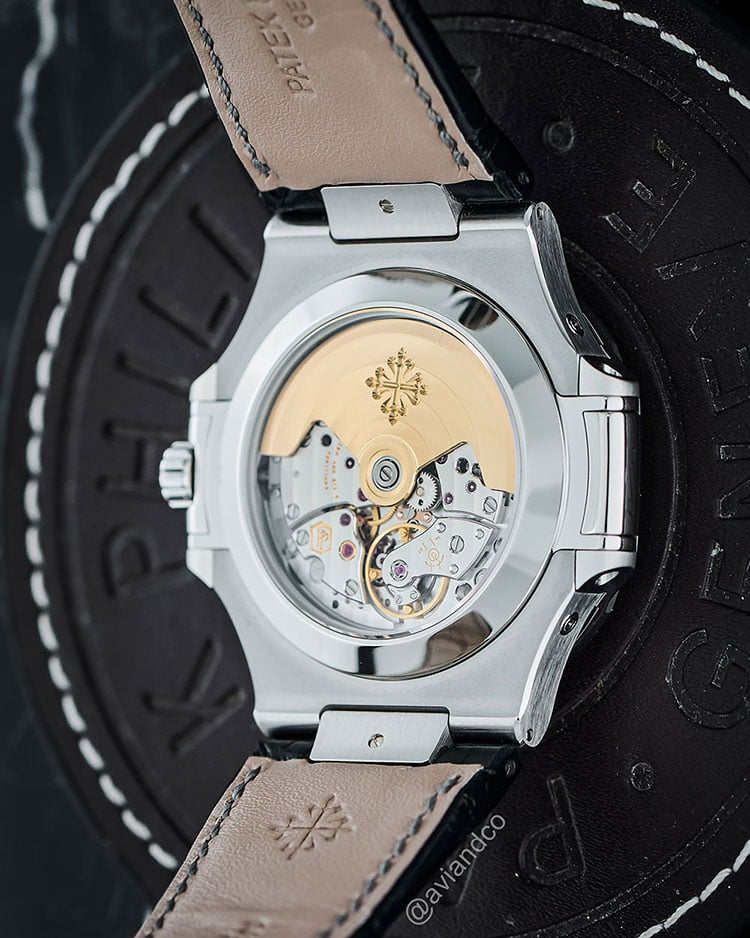
Automatic Movement Inside a Patek Philippe Nautilus Watch
The Evolution of Nautilus Movements
The original Reference 3700 was powered by the Caliber 28-255 C, an ultra-thin automatic movement derived from the legendary Jaeger-LeCoultre Caliber 920. Although the movement was not manufactured entirely in-house, it was extensively finished and modified to Patek Philippe’s exacting standards.
Its slim construction allowed the original Nautilus to maintain an elegant profile while delivering dependable performance, helping establish one of the defining characteristics of the collection: exceptional mechanical sophistication in an ultra-thin sports watch.
As the Nautilus collection expanded, Patek Philippe gradually transitioned to proprietary in-house movements. This shift allowed the company greater control over performance, finishing, long-term reliability, and the integration of increasingly complex complications.
One of the most significant milestones came in 2006 with the introduction of the Caliber 324 SC, which powered the Reference 5711. The movement offered improved efficiency, a central seconds hand, a date display, and refined finishing that met the standards expected of modern Patek Philippe watches.
More recently, the company introduced the Caliber 26-330 S C, an evolution of the 324 architecture featuring improvements to winding efficiency, seconds-hand stability, and overall precision. This movement powers the current Reference 5811 and reflects Patek Philippe’s philosophy of continuous refinement rather than radical redesign.
Mechanical Complications Across the Nautilus Collection
While the earliest Nautilus references focused on simplicity, the collection has evolved into one of Patek Philippe’s most technically diverse product families.
Among the most practical complications is the Annual Calendar, introduced to the Nautilus through the Reference 5726. Unlike a traditional calendar, an annual calendar automatically accounts for months with 30 and 31 days, requiring manual adjustment only once each year at the end of February. For many collectors, it represents an ideal balance between everyday convenience and mechanical sophistication.
The Perpetual Calendar, found in the Reference 5740, represents one of the highest achievements in traditional watchmaking. Correctly programmed, a perpetual calendar automatically adjusts for varying month lengths and leap years, requiring no manual correction until the year 2100. Integrating this complication into the slim Nautilus case while preserving the collection’s elegant proportions is widely regarded as one of Patek Philippe’s greatest technical accomplishments.
Chronograph enthusiasts often gravitate toward the Reference 5980 and Reference 5990, both of which feature sophisticated flyback chronograph movements. Unlike a conventional chronograph, a flyback mechanism allows the user to reset and restart timing with a single press of the pusher, making it particularly useful for measuring consecutive intervals.
The Reference 5990 further enhances functionality by incorporating Travel Time, Patek Philippe’s dual-time-zone system. Independent hour hands allow travelers to display local and home time simultaneously while maintaining a clean, intuitive dial layout. This practical complication has made the 5990 one of the most versatile Nautilus references for frequent international travelers.
Several references, including the celebrated 3712 and 5712, combine a moon phase display, power reserve indicator, small seconds, and date display into an asymmetrical layout that has become one of the collection’s defining visual signatures. Although mechanically sophisticated, these complications are arranged with remarkable balance, demonstrating Patek Philippe’s ability to integrate technical complexity without sacrificing legibility or design harmony.
Finishing and Craftsmanship
A movement’s technical specifications tell only part of the story. What truly distinguishes a Patek Philippe movement is its level of finishing.
Every Nautilus movement receives meticulous hand-finishing that includes Geneva striping, polished bevels, circular graining, chamfered edges, and beautifully decorated gold rotors. Even components rarely seen by the owner are finished to exceptionally high standards, reflecting Patek Philippe’s long-standing belief that craftsmanship should extend to every surface.
Modern Nautilus movements also meet the requirements of the Patek Philippe Seal, an internal quality standard introduced in 2009. The seal encompasses movement accuracy, finishing, durability, serviceability, and long-term performance, reinforcing the brand’s commitment to producing watches intended to be passed from one generation to the next.
Why Collectors Value Nautilus Movements
For many collectors, the movement is what transforms the Nautilus from a beautifully designed sports watch into a true work of haute horlogerie.
Each caliber reflects decades of technical development, while every complication demonstrates Patek Philippe’s ability to solve complex mechanical challenges without compromising the collection’s signature elegance. Rather than introducing complications simply to increase feature counts, Patek Philippe integrates them thoughtfully, ensuring that every display remains functional, balanced, and visually harmonious.
This philosophy has helped the Nautilus achieve a rare distinction within luxury watchmaking. It is celebrated not only for its iconic exterior design but also for the exceptional engineering beneath the dial. Whether equipped with a three-hand automatic movement or an ultra-thin perpetual calendar, every Nautilus embodies the same commitment to precision, refinement, and enduring craftsmanship that has defined Patek Philippe for nearly two centuries.
Technical Specifications at a Glance
| Feature | Details |
| Movement Type | Automatic mechanical |
| Notable Calibers | 28-255 C, 335 SC, 324 SC, 26-330 S C, CH 28-520 C, CH 28-520 C FUS, 240 Q |
| Complications Available | Date, Power Reserve, Moon Phase, Small Seconds, Annual Calendar, Chronograph, Travel Time, Perpetual Calendar |
| Certification | Patek Philippe Seal (modern references) |
| Rotor Material | 21K gold (varies by caliber) |
| Typical Power Reserve | Approximately 35–55 hours, depending on the movement |
| Frequency | Generally 28,800 vibrations per hour (4 Hz) on modern calibers |
Market Values & Investment Performance
Few modern watch collections have experienced the dramatic appreciation that the Patek Philippe Nautilus has seen. Since its introduction in 1976, the collection has evolved from a niche luxury sports watch into one of the world’s most actively traded and closely followed assets in the secondary watch market.
While many luxury watches retain value over time, relatively few have consistently generated the level of collector demand, liquidity, and long-term appreciation seen across the most desirable Nautilus references.
That said, one of the biggest misconceptions surrounding the Nautilus is that every reference is automatically a great investment. In reality, Patek Philippe Nautilus 7010 or the Nautilus 7118, can also see strong resale values. This is especially true of gem-set varieties, which give Patek Philippe yet another opportunity to showcase their strength in meticulous design and finishing.
What Influences Market Value?
Two examples of the same reference can differ in value by tens of thousands of dollars. Several factors contribute to these differences:
- Condition: Sharp case edges, original finishing, and an unpolished case are highly desirable.
- Completeness: Original box, Certificate of Origin, manuals, hang tags, and accessories often command meaningful premiums.
- Service History: Factory service documentation from Patek Philippe can increase buyer confidence.
- Dial Variation: Certain dial colors or rare production variants are considerably more valuable than standard configurations.
- Provenance: Watches owned by notable collectors or accompanied by documented history may achieve substantial premiums at auction.
- Production Rarity: Short-production references or uncommon precious-metal variants generally experience stronger collector demand over time.
For serious collectors, these details often matter more than the reference number itself.
Is the Nautilus a Good Investment?
The Patek Philippe Nautilus has earned a reputation as one of the strongest-performing luxury watch collections of the past several decades, but it should not be viewed as a guaranteed investment.
Like any collectible asset, values fluctuate. Economic conditions, interest rates, changing collector preferences, and broader trends within the luxury market all influence pricing. Even iconic references can experience periods of appreciation, stabilization, or temporary decline.
For that reason, experienced collectors generally follow a simple philosophy: Buy the reference you genuinely want to own, not the one you hope will appreciate the fastest.
Historically, the watches that perform best over decades are those with lasting design significance, mechanical excellence, and broad collector appeal rather than those driven primarily by short-term speculation. The Nautilus satisfies all three of those characteristics.
Its nearly fifty-year history, Gérald Genta’s timeless design, Patek Philippe’s disciplined production strategy, and enduring global demand have established it as one of the defining luxury watches of the modern era. The Nautilus has repeatedly demonstrated an ability to remain desirable across changing market cycles, a quality few collectible watches can claim.
Estimated Secondary Market Values of Major Patek Philippe Nautilus References
Note: The prices below represent estimated market ranges for complete examples in very good to excellent condition with original box and papers. Actual values may vary depending on condition, dial variation, production year, provenance, service history, and overall market demand.
| Reference | Production Years | Estimated Market Value (USD)* | Collector Demand | Investment Outlook |
| 3700/1A | 1976–1990 | $110,000–$180,000 | ★★★★★ | Excellent |
| 3800 | 1981–2006 | $35,000–$65,000 | ★★★★☆ | Very Strong |
| 3710 | 1998–2006 | $55,000–$90,000 | ★★★★☆ | Strong |
| 3711 | 2004–2006 | $90,000–$150,000 | ★★★★★ | Excellent |
| 3712 | 2005–2006 | $120,000–$200,000 | ★★★★★ | Excellent |
| 5711/1A | 2006–2021 | $90,000–$140,000 | ★★★★★ | Excellent |
| 5712/1A | 2006–Present | $85,000–$130,000 | ★★★★★ | Excellent |
| 5726 | 2010–Present | $55,000–$80,000 | ★★★★☆ | Strong |
| 5980 | 2006–Present | $95,000–$150,000 | ★★★★★ | Excellent |
| 5990 | 2014–Present | $110,000–$170,000 | ★★★★★ | Excellent |
| 5740/1G | 2018–Present | $180,000–$260,000 | ★★★★★ | Excellent |
| 5811/1G | 2022–Present | $110,000–$160,000 | ★★★★★ | Very Strong |
Collector Commentary
Best Entry Point
Reference 3800: Often overshadowed by the Jumbo references, the 3800 offers vintage Nautilus heritage, versatile sizing, and comparatively accessible pricing. It remains one of the strongest values for collectors entering the Nautilus market.
Best Long-Term Collector’s Watch
Reference 3700: As the original Nautilus designed by Gérald Genta, the 3700 combines historical significance with enduring collector demand. Well-preserved examples continue to be among the most desirable vintage luxury sports watches.
Best Modern Icon
Reference 5711: Although production ended in 2021, the 5711 remains the reference most collectors associate with the modern Nautilus. Its balanced proportions and historical importance continue to support exceptionally strong demand.
Best Complicated Nautilus
Reference 5740: The 5740 pairs one of Patek Philippe’s signature complications—the perpetual calendar—with the slim Nautilus case. Its technical sophistication, restrained production, and elegant execution make it one of the collection’s flagship references.
Best Under-the-Radar Buy
Reference 5726: For collectors seeking additional complications without the premium commanded by the 5711 or 5712, the Annual Calendar 5726 offers one of the strongest value propositions in the Nautilus lineup.
Buying Guide: Choosing the Right Patek Philippe Nautilus
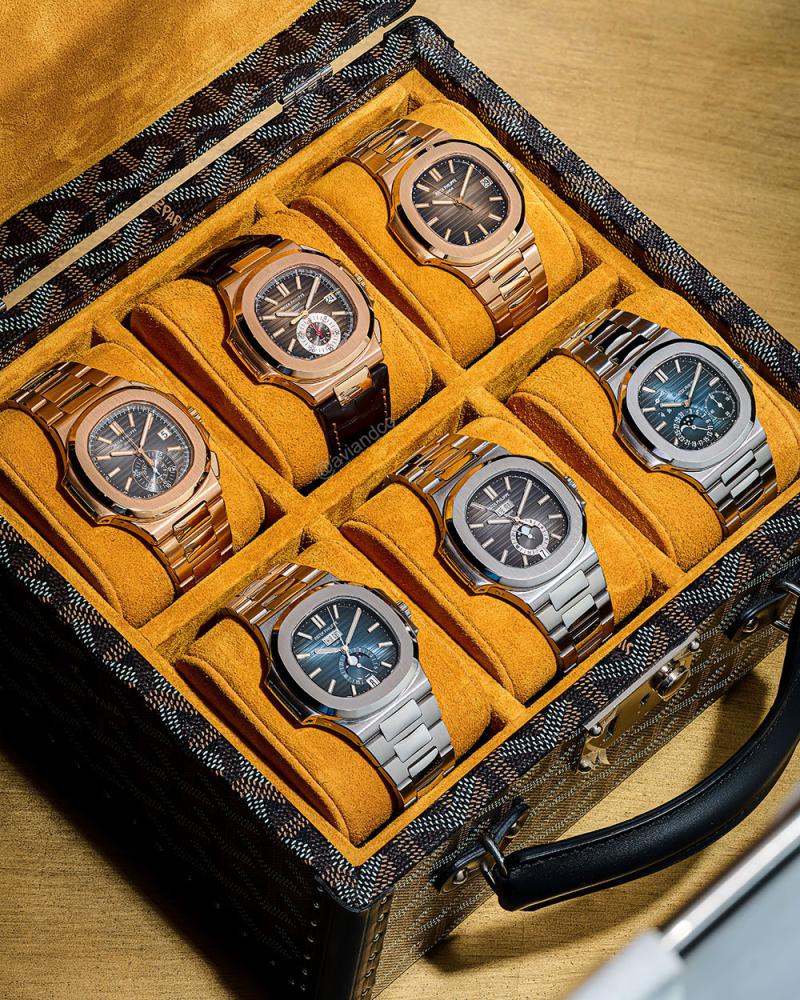
Patek Philippe Nautilus Watches in a Collector's Watch Box
Selecting the right Patek Philippe Nautilus is about more than finding the most valuable or recognizable reference. Each model was designed with a different type of collector in mind, whether your priority is historical significance, everyday wearability, mechanical complexity, or long-term collectability.
If you’re purchasing your first Nautilus, the Reference 5711 (when available on the secondary market) and the current 5811 represent a modern expression of Gérald Genta’s original vision. Their clean three-hand layouts, balanced proportions, and timeless aesthetics make them the references most closely associated with the Nautilus name.
Collectors who appreciate additional mechanical complexity without sacrificing everyday practicality often gravitate toward the 5712, whose moon phase, power reserve indicator, and date display create one of the most distinctive dials in modern watchmaking. Those seeking even greater functionality may prefer the 5726 Annual Calendar, 5980 Chronograph, or 5990 Travel Time Chronograph, each offering a different balance of complications and versatility.
For vintage enthusiasts, the Reference 3700 remains the ultimate collector’s piece. As the original Nautilus introduced in 1976, it represents one of the most historically significant luxury sports watches ever produced. The 3800, meanwhile, offers much of the same vintage charm in a slightly smaller package and is often considered one of the collection’s most overlooked values.
Regardless of which reference you choose, condition should always take priority over price. A well-preserved example with its original box, Certificate of Origin, service records, and matching components will almost always prove more desirable than a less expensive watch with questionable history. Original finishing, sharp case lines, and documented provenance can significantly influence both collectability and long-term value.
While many references have performed exceptionally well over time, the strongest collections are built around watches their owners enjoy wearing. The Nautilus has remained one of the world’s most desirable luxury watches for five decades because it combines timeless design, exceptional craftsmanship, and everyday wearability in a way few timepieces can match.
Whether you are searching for a vintage Reference 3700, a modern 5811, or one of the collection’s highly complicated models, taking the time to understand each reference’s history, movement, and market position will help ensure you choose the Nautilus that best fits your collecting goals.
Which Nautilus Is Right for You?
| If you want... | Recommended Reference | Why |
| The original icon | 3700 | The watch that started the Nautilus legacy. |
| The best modern classic | 5711 | The definitive contemporary Nautilus and one of the most recognizable luxury watches ever made. |
| The current production flagship | 5811 | The modern evolution of the 5711 with refined engineering and white-gold construction. |
| The best value | 3800 | Vintage appeal with a more accessible price point. |
| Everyday complications | 5712 | Moon phase, power reserve, and date in an iconic asymmetrical layout. |
| Frequent travel | 5990 | Combines dual time zones with a flyback chronograph. |
| Maximum mechanical sophistication | 5740 | Ultra-thin perpetual calendar showcasing Patek Philippe’s technical expertise. |
| A daily-wear chronograph | 5980 | Sporty, practical, and one of the collection’s most balanced chronographs. |
Frequently Asked Questions About the Patek Philippe Nautilus
What is the Patek Philippe Nautilus?
The Patek Philippe Nautilus is a luxury sports watch introduced in 1976 and designed by Gérald Genta. Originally launched as the Reference 3700, it pioneered the concept of the high-end stainless steel sports watch with an integrated bracelet. Today, it is one of the world’s most collectible and recognizable luxury watch collections.
When was the Patek Philippe Nautilus introduced?
The Nautilus was introduced in 1976 with the release of the Reference 3700/1A.
Who designed the Patek Philippe Nautilus?
The Nautilus was designed by the legendary Swiss watch designer Gérald Genta, who also designed the Audemars Piguet Royal Oak and several other iconic luxury watches.
What inspired the Nautilus design?
Gérald Genta designed the Nautilus after the rounded portholes found on transatlantic ocean liners. The distinctive bezel and side "ears" reflect this nautical inspiration.
What was the first Nautilus reference?
The first Nautilus was the Reference 3700/1A, commonly known as the “Jumbo.”
Why is the Nautilus called the Jumbo?
The original Reference 3700 measured approximately 42 mm across the case, making it exceptionally large compared to most watches of the 1970s.
Why is the Patek Philippe Nautilus so expensive?
The Nautilus commands premium prices because of its limited production, exceptional finishing, mechanical craftsmanship, historical significance, and consistently strong collector demand.
Is the Nautilus a good investment?
Many Nautilus references have appreciated significantly over time, but no watch should be viewed as a guaranteed investment. Long-term performance depends on the specific reference, rarity, condition, provenance, and broader market conditions.
Does Patek Philippe still make the Nautilus?
Yes. Patek Philippe continues to produce the Nautilus collection, although several references have been discontinued over the years.
Is the Nautilus 5711 discontinued?
Yes, Patek Philippe discontinued the Reference 5711 in 2021. This led to it being one of the most sought-after modern Nautilus references.
What replaced the Nautilus 5711?
The Reference 5811/1G was introduced in 2022 as the successor to the 5711.
What is the difference between the Nautilus 5711 and the 5811?
The 5811 features a slightly larger case, white-gold construction, an updated movement, improved bracelet clasp, and subtle case refinements while maintaining the overall design language of the 5711.
What is the most collectible Patek Philippe Nautilus watch?
Collectors often consider the original Reference 3700 and the discontinued Reference 5711 among the most collectible Nautilus models due to their historical importance and enduring demand.
Which Nautilus watch is best for everyday wear?
Many collectors consider the 5711, 5811, and 5712 to be among the best everyday Nautilus references because they balance versatility, comfort, and timeless design.
Which Nautilus watch is best for collectors?
The answer depends on the collector’s goals, but the 3700, 3712, 5711, 5712, and 5740 are widely regarded as cornerstone references.
What is the rarest Nautilus watch?
Several gem-set editions, limited-production references, and unique auction pieces rank among the rarest Nautilus watches. Among standard production models, short-lived references such as the 3711 and 3712 are particularly sought after.
Which Patek Philippe Nautilus has a perpetual calendar?
The Reference 5740 features an ultra-thin perpetual calendar movement.
Which Patek Philippe Nautilus has a chronograph?
The References 5980 and 5990 include flyback chronograph complications.
Which Patek Philippe Nautilus has a moon phase?
The References 3712, 5712, and 5740 include moon phase displays.
Which Nautilus watch has a travel time function?
The Reference 5990 combines a Travel Time complication with a flyback chronograph.
What movement does the Patek Philippe Nautilus use?
Different references use different calibers, including the 28-255 C, 324 SC, 26-330 S C, CH 28-520 C, CH 28-520 C FUS, and 240 Q.
Is every Nautilus watch automatic?
Nearly all modern Nautilus references feature automatic mechanical movements. Certain quartz-powered ladies’ references have also been produced.
Is the Patek Philippe Nautilus waterproof?
The Nautilus is water resistant rather than waterproof. Water resistance varies by reference, but many models are rated to approximately 120 meters (394 feet).
How often should a Patek Philippe Nautilus be serviced?
Patek Philippe generally recommends periodic servicing based on wear and condition. Many collectors have their watches inspected every few years and serviced as needed by authorized service centers.
Can you swim with a Patek Philippe Nautilus?
Many Nautilus references are suitable for swimming when their water resistance is intact, but owners should ensure the watch has been properly maintained and pressure-tested before exposing it to water.
What materials are used to make a Patek Philippe Nautilus watch?
Depending on the reference, the Nautilus has been produced in stainless steel, white gold, yellow gold, rose gold, platinum, two-tone configurations, and gem-set variations.
What dial colors are available for a Patek Philippe Nautilus?
Over the years, the Nautilus has been offered with blue, black, white, gray, olive green, chocolate brown, opaline, salmon, Tiffany Blue, and various gem-set dial configurations.
What is the most affordable Nautilus watch?
Prices fluctuate, but the vintage Reference 3800 and certain ladies’ references are often among the most accessible entry points into the Nautilus collection.
Why is there such a long waiting list for the Patek Philippe Nautilus?
Limited production, high global demand, and Patek Philippe’s commitment to controlled manufacturing have historically contributed to long waiting lists for many Nautilus references.
How can I tell if a Patek Philippe Nautilus is authentic?
Authenticity should be evaluated using the movement, dial, case finishing, hallmarks, bracelet construction, serial numbers, and documentation. Purchasing from a trusted dealer significantly reduces the risk of acquiring a counterfeit watch.
Is the Nautilus better than the Royal Oak?
Neither watch is objectively better. The Nautilus is generally known for its elegant, understated design, while the Royal Oak emphasizes a more angular, industrial aesthetic. Preference ultimately depends on individual taste.
Is the Nautilus better than the Rolex Daytona?
The Nautilus and Daytona serve different purposes. The Nautilus emphasizes refined luxury sports watch design, while the Daytona is a purpose-built chronograph with a motorsport heritage.
Why is the Patek Philippe Nautilus so difficult to buy?
It is challenging to purchase a Patek Philippe Nautilus watch because demand consistently outpaces supply. Patek Philippe intentionally limits production to maintain quality and exclusivity, resulting in limited availability through authorized dealers and on the secondary market.
What makes the Nautilus different from the Aquanaut?
Although both are luxury sports watches from Patek Philippe, the Nautilus features an integrated metal bracelet and porthole-inspired case, while the Aquanaut has a larger and more contemporary rounded octagonal design paired with a “tropical” rubber strap.
Does the Patek Philippe Nautilus hold its value?
Many Patek Philippe Nautilus references have demonstrated excellent value retention over time, although prices fluctuate with market conditions and individual watch characteristics.
Which Nautilus watch is best for first-time buyers?
The ideal first Nautilus depends on budget and collecting goals, but the 3800, 5711, 5712, and 5811 are frequently recommended because they represent the collection’s defining design language.
What does "integrated bracelet" mean?
An integrated bracelet is designed to flow seamlessly into the watch case without traditional protruding lugs, creating one continuous design.
What is the Patek Philippe Seal?
Introduced in 2009, the Patek Philippe Seal is the brand’s proprietary quality certification covering movement finishing, precision, durability, and overall watch performance.
Why is the Patek Philippe Nautilus considered iconic?
The Nautilus transformed luxury sports watch design by combining exceptional finishing, mechanical excellence, and everyday versatility. Its influence continues to shape modern watchmaking nearly five decades after its introduction.
Which Patek Philippe Nautilus should I buy?
The best Nautilus depends on your priorities. Collectors seeking historical significance often favor the 3700, those wanting the quintessential modern Nautilus frequently choose the 5711 or 5811, while enthusiasts looking for additional complications may prefer the 5712, 5726, 5980, 5990, or 5740.