

Rolex Submariner Reference Guide: History, Variations, Timeline, Prices, and Market Values
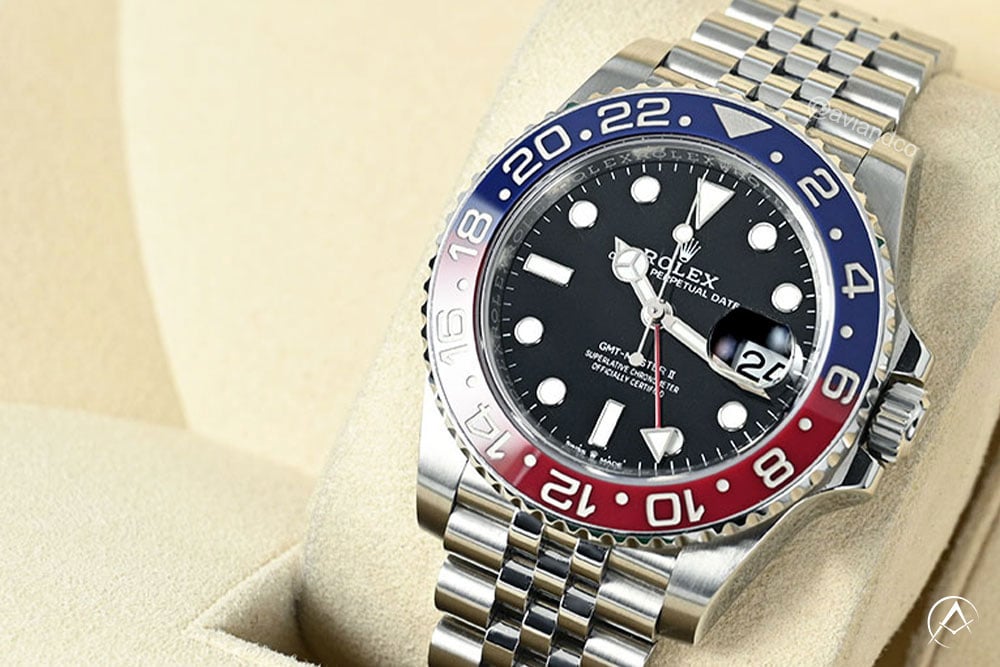
The Rolex GMT-Master II is one of the world’s most recognizable travel watches, combining a distinctive 24-hour bezel with the ability to display multiple time zones simultaneously. Introduced in 1982, the GMT-Master II evolved from the original Rolex GMT-Master, a professional tool watch developed during the golden age of international air travel. Today, the collection is prized for its practical functionality, unmistakable design, extensive reference history, and enduring collector appeal.
The story of the GMT-Master II begins with the original GMT-Master line, which was introduced in 1955 as international commercial aviation was rapidly expanding. Its defining feature was an additional 24-hour hand paired with a rotating 24-hour bezel, allowing pilots and other travelers to track another time zone. The model became closely associated with aviation through its relationship with Pan American (Pan Am) World Airways. The GMT-Master became Pan Am’s official watch and was used as a navigation aid by the airline’s pilots.
The GMT-Master II represented an important technical advancement when it arrived in 1982 with Reference 16760. Unlike the original GMT-Master, its conventional local hour hand could be adjusted forward or backward in one-hour increments independently of the minute, seconds, and 24-hour hands. Travelers could therefore change local time after crossing a time zone without stopping the watch or disturbing their reference time. That independently adjustable hour hand remains the defining mechanical characteristic of the GMT-Master II.
Over the decades, Rolex has continually refined the collection while preserving its fundamental identity. The GMT-Master II has evolved through aluminum and ceramic bezel inserts, multiple generations of automatic movements, updated cases and bracelets, and combinations of Oystersteel, gold, and Rolesor materials. Its bi-color bezels have also become cultural signatures in their own right, inspiring collector nicknames such as Pepsi, Coke, Batman, Batgirl, Root Beer, and Sprite.
Modern GMT-Master II watches retain the collection’s characteristic 40 mm Oyster case, bidirectional 24-hour bezel, date display with Cyclops lens, and independent local hour hand. Current models with the Calibre 3285 offer approximately 70 hours of power reserve and allow local time to be changed without stopping the movement or affecting the 24-hour hand.
More than four decades after the GMT-Master II debuted (and more than 70 years after the original GMT-Master established Rolex’s travel-watch formula) the collection remains one of the defining aviation watches in modern horology.
This complete Rolex GMT-Master II reference guide explores the collection’s history, major references, production timeline, movements, bezel variations, market values, collector terminology, and buying considerations. From the inaugural Reference 16760 to today’s ceramic-bezel models, we hope to provide collectors with a comprehensive resource for understanding the evolution of one of Rolex’s most important professional watches.
Rolex GMT-Master II At a Glance
Scan the basics features of Rolex GMT-Master II watches that any savvy collector needs to know before purchasing one.
| Collection | Rolex GMT-Master II |
| Introduced | 1982 |
| First Reference | 16760 |
| Predecessor | Rolex GMT-Master |
| Category | Professional travel/GMT watch |
| Key Function | Independently adjustable local hour hand with 24-hour reference-time display |
| Signature Feature | Bidirectional, two-color 24-hour bezel |
| Bezel Material | Aluminum (historic), Cerachrom ceramic (modern) |
| Current Case Size | 40 mm |
| Current Movement | Calibre 3285 |
| Current Power Reserve | Approximately 70 hours |
| Current Water Resistance | 100 meters (330 feet) |
| Notable Bezel Variations | Red/blue, blue/black, brown/black, green/black, grey/black |
| Popular Collector Nicknames | Pepsi, Coke, Batman, Batgirl, Root Beer, Sprite |
| Bracelet Options | Oyster and Jubilee |
| Production Status | Currently in production |
History of the Rolex GMT-Master II
Few watches are as closely associated with international travel as the Rolex GMT-Master II. Its history stretches back to the rapid expansion of commercial aviation in the 1950s, when long-distance flights were transforming how people experienced time. Crossing multiple time zones in a matter of hours created a practical problem for pilots and travelers: How would one keep track of both the local time and the time at home. Rolex responded with a watch that would become one of the defining professional models in its catalog.
Here, we track the history of the Rolex GMT-Master II line from the inaugural days of the GMT-Master collection to modern iterations of this popular pilot’s watch.
1955: The Original GMT-Master
The story of the GMT-Master II line begins with the original Rolex GMT-Master, which Rolex launched in 1955. In the 1950s, commercial air travel was expanding rapidly and transcontinental flights were becoming increasingly common. Rolex developed a watch capable of displaying another time zone using an additional hand that completed one revolution every 24 hours and a rotating bezel graduated from 1 to 24.
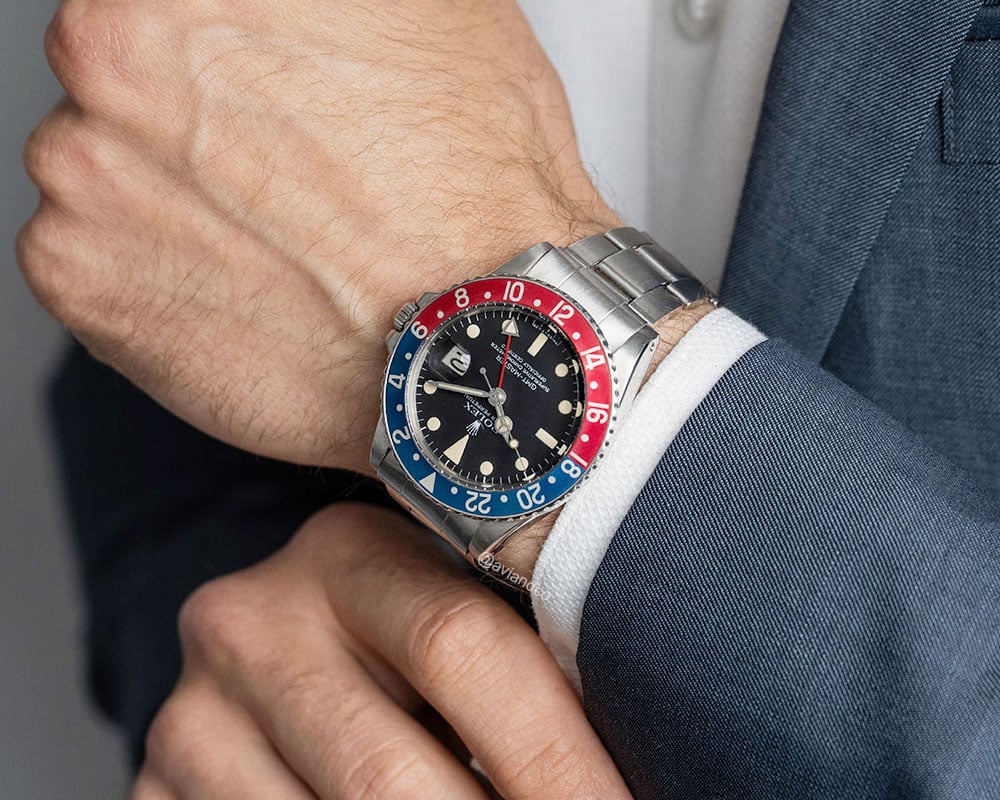
The GMT-Master became particularly associated with Pan American World Airways (Pan Am). The watch was adopted by Pan Am flight crews and became the airline’s official watch. In 1959, the captain of the first nonstop Pan Am Jet Clipper flight from New York to Moscow wore a GMT-Master and used it as a navigation aid during the journey. This rich history in the world of aviation helped establish the identity that still surrounds the collection today.
The original GMT-Master’s two-color bezel also served a practical purpose. By dividing the 24-hour scale into contrasting sections, the bezel made it easier to distinguish daytime from nighttime hours when reading the additional time zone.
Over the following decades, the GMT-Master evolved through references such as the 6542 and 1675, becoming one of Rolex’s most recognizable professional watches.
But the original GMT-Master had an important functional limitation: Its conventional 12-hour hand could not be adjusted independently from the other timekeeping hands. Rolex’s solution would eventually create an entirely new collection.
1982: The GMT-Master II Is Born
In 1982, Rolex introduced a new movement that changed how its signature travel watch functioned. The new mechanism allowed the conventional hour hand to be adjusted independently of the minute, seconds, and 24-hour hands. Pulling the crown to the appropriate position allowed the local hour hand to jump forward or backward in one-hour increments without stopping the watch or disturbing the reference time.
Rolex gave the watch equipped with this new functionality a new name: the GMT-Master II, and its inaugural model was the Reference 16760.
The time-setting distinction remains fundamental to understanding the collection:
- GMT-Master: the 24-hour hand is linked to the conventional hour hand.
- GMT-Master II: the conventional local hour hand can be adjusted independently.
The GMT-Master II therefore offered greater flexibility to travelers. The wearer could leave the 24-hour hand displaying home or reference time and adjust only the conventional hour hand upon arriving in a new time zone. The rotating bezel could also be repositioned to calculate an additional time zone when desired.
Reference 16760: The “Fat Lady”
The original GMT-Master II Reference 16760 was significantly different from the GMT-Master watches that preceded it. Its new movement, the Calibre 3085, required a thicker case. The watch featured broader proportions, sapphire crystal, and white gold around the hour markers.
Those dimensions eventually produced one of the most memorable collector nicknames in Rolex history: the “Fat Lady.” The reference is sometimes also called the “Sophia Loren.”
The Reference 16760 also introduced a distinctive bezel combination. Rather than the traditional red-and-blue configuration associated with earlier GMT-Masters, the new watch featured a burgundy and black 24-hour bezel insert. Historical materials note that this color combination was exclusive to the new GMT-Master II at its launch.
Collectors would eventually nickname this color scheme “Coke,” complementing the unofficial “Pepsi” nickname used for red-and-blue GMT bezels. The 16760 was produced for a relatively short period of time, making it especially desirable today. It remains significant as the watch that established the mechanical formula for every subsequent GMT-Master II.
The Reference 16710 Era
By the end of the 1980s, Rolex had developed a slimmer successor to the so-called “Fat Lady”: Reference 16710. The 16710 would prove to be one of the longest-running and most recognizable GMT-Master II references. Compared with the thicker 16760, it featured more streamlined case proportions while retaining the independent local-hour functionality that defined the GMT-Master II.
One reason the 16710 remains especially popular among collectors is its variety of aluminum bezel inserts. The aluminum inserts could also change appearance with age and exposure, sometimes producing faded colors that make individual vintage and neo-vintage watches visually distinctive. Depending on the configuration and production period, buyers could encounter a few different colorways, each with their own fun nickname:
- Red and blue, commonly called “Pepsi”
- Red and black, commonly called “Coke”
- All black
The 16710’s long production period also encompassed numerous technical changes, including updates to luminous material, bracelet construction, dial details, and movements. Certain late-production examples are particularly interesting to collectors because some received Calibre 3186, the movement that would become associated with the following generation.
Two Generations Coexist
An important and sometimes overlooked part of GMT history is that the introduction of the GMT-Master II did not immediately end production of the original GMT-Master. Instead, Rolex continued producing both collections simultaneously: The GMT-Master and GMT-Master II coexisted until 2000.
As such, the 1980s and 1990s represented an unusual period in which customers could choose between the traditional GMT-Master architecture and the more advanced GMT-Master II with its independently adjustable local hour hand. When the original GMT-Master was discontinued in 2000, the GMT-Master II became the sole continuation of Rolex’s famous travel-watch lineage.
2005: The GMT-Master II Enters the Ceramic Era
Another major transformation arrived in 2005, when Rolex introduced a GMT-Master II featuring a black ceramic bezel insert. This began the collection’s transition away from the aluminum inserts that had characterized earlier generations. Rolex later registered the name Cerachrom in 2007 for its ceramic bezel technology.
Ceramic offered important practical advantages. Rolex describes their Cerachrom material as extremely hard, virtually scratchproof, corrosion resistant, and unaffected by ultraviolet light, helping the bezel retain its color over long periods.
The ceramic generation also brought substantial visual changes to the GMT-Master II. References such as the 116710LN featured more substantial cases, larger hour markers, updated bracelets and clasps, and a more contemporary wrist presence. The basic 40 mm diameter remained, but the GMT-Master II looked and felt considerably more substantial than the previous 16710 generation.
2013: The Blue-and-Black Ceramic Bezel
Producing a seamless two-color ceramic bezel insert was considerably more difficult than a single-color bezel. Rolex achieved that milestone in 2013, introducing the first two-color Cerachrom GMT-Master II bezel in blue and black. Rolex describes the single-piece two-color ceramic insert as a world first in watchmaking. The configuration became known among collectors as the “Batman.”
Its importance goes beyond the nickname. The watch demonstrated that Rolex could recreate the GMT-Master’s traditional day/night bezel concept using modern ceramic technology, opening the door for several color combinations that now define the collection.
2014: The "Pepsi" Returns in Ceramic
One year later after the debut of the two-color Cerachrom insert, Rolex used it for the collection’s historically significant red-and-blue combination. Creating red ceramic presented a technical challenge, but the resulting look allowed Rolex to recreate the classic GMT color scheme using a modern material.
Rolex introduced the red-and-blue ceramic GMT-Master II in 2014. Initially, the ceramic "Pepsi" configuration appeared in white gold rather than stainless steel, reinforcing its position as a premium variation within the collection.
2018: A New Generation of GMT-Master II
In 2018, Rolex introduced a new generation of GMT-Master II watches powered by Calibre 3285. The movement incorporated Rolex’s newer-generation architecture and offered approximately 70 hours of power reserve. That year also brought some aesthetic developments.
The red-and-blue Cerachrom bezel became available on an Oystersteel GMT-Master II paired with a Jubilee bracelet, creating one of the most recognizable modern GMT configurations. Rolex also introduced the brown-and-black ceramic bezel on Everose gold and Everose Rolesor models. Collectors adopted the historic “Root Beer” nickname for these brown-and-black configurations, although the term itself is unofficial.
2022: The Left-Handed GMT-Master II
In 2022, Rolex brought us another unconventional new configuration. The Reference 126720VTNR repositioned the winding crown and crown guard to the left side of the case, with the date aperture and Cyclops lens correspondingly moved to 9 o’clock. The watch also introduced a green-and-black Cerachrom bezel to the GMT-Master II collection.
The configuration is widely nicknamed the “Sprite” by collectors, though, as with Pepsi, Batman, and Root Beer, this is not Rolex’s official model name. The 126720VTNR demonstrated how Rolex could significantly alter the familiar GMT-Master II layout without changing the core functionality that had defined the collection since 1982.
More Than Four Decades of the GMT-Master II
The history of the Rolex GMT-Master II is a story of gradual technical refinement.The core concept established by Reference 16760 remains recognizable today: an arrow-tipped 24-hour hand displays reference time while the conventional hour hand can be adjusted independently to show local time. A bidirectional 24-hour bezel provides additional flexibility for travelers.
What has changed are the materials, movements, bracelets, bezel technology, and execution. The thicker 16760 gave way to the slimmer 16710. Aluminum bezels yielded to Cerachrom ceramic. Calibre 3085 evolved through subsequent movement generations to today’s Calibre 3285. New color combinations expanded the collection while historically important colorways such as red and blue were reinterpreted using modern manufacturing technology.
Even with these shifts, the GMT-Master II remains fundamentally connected to the problem Rolex set out to solve decades ago: helping travelers understand time across different parts of the world. From the original 1955 GMT-Master to the inaugural GMT-Master II introduced in 1982 and the ceramic models of today, that connection between time and travel has remained at the center of one of Rolex’s most enduring professional watch families.
Every Major Rolex GMT-Master II Reference
Since the first GMT-Master II appeared in the early 1980s, Rolex has continually refined its professional travel watch while preserving the basic formula that made it distinctive: an independently adjustable local hour hand, a separate 24-hour hand, a rotating 24-hour bezel, and an Oyster case.
Unlike collections that have undergone dramatic changes in appearance, the GMT-Master II has evolved incrementally. Movements have improved, aluminum bezel inserts have given way to Cerachrom ceramic, bracelets and cases have become more substantial, and new color combinations have expanded the collection. Still, a modern GMT-Master II remains immediately recognizable as a descendant of the original Reference 16760.
For collectors, the GMT-Master II can be divided into three broad generations: the inaugural 16760, the long-running 16710 era, and the modern six-digit ceramic references. We will now walk through these key eras, emphasizing the important references collectors need to know.
Rolex GMT-Master II Reference 16760: The Original “Fat Lady”
The Reference 16760, introduced in 1982, established the GMT-Master II collection and introduced the feature that continues to distinguish it from the original GMT-Master: an independently adjustable conventional hour hand.
Powered by Calibre 3085, the watch allowed the wearer to move the local hour hand forward or backward in one-hour increments without disturbing the other timekeeping hands. Combined with the 24-hour hand and rotating bezel, this allowed the GMT-Master II to display multiple time zones more conveniently.
The new movement required a thicker case than previous GMT-Master watches. Larger crown guards and a broader bezel contributed to its substantial appearance, leading collectors to nickname the reference the “Fat Lady.” The 16760 also introduced a distinctive burgundy and black aluminum bezel insert, a combination exclusive to this reference at the time and now widely known among collectors as “Coke.”
Because of its relatively short production period and status as the first GMT-Master II, the 16760 occupies an important position among collectors.
| Introduced | 1982 |
| Material | Stainless steel |
| Movement | Calibre 3085 |
| Bezel | Burgundy/black aluminum |
| Crystal | Sapphire |
| Collector Nickname | Fat Lady / Coke |
| Historical Significance | First GMT-Master II |
Rolex GMT-Master II Reference 16710: The Neo-Vintage Classic
The Reference 16710 succeeded the 16760 around the end of the 1980s and would remain in production until approximately 2007, an unusually long run. Its case was slimmer than the 16760, creating proportions that many collectors now associate with neo-vintage Rolex sports watches.
Most examples are powered by Calibre 3185, although some watches produced near the end of the reference’s life received the newer Calibre 3186. These transitional 3186 examples have become particularly interesting to collectors.
The 16710 was offered with three primary aluminum bezel configurations: red/blue (called the “Pepsi”), red/black (called the “Coke”), and all black. This variety is one reason the 16710 remains such a compelling collector reference. Unlike most modern Rolex watches, its aluminum bezel inserts can also develop visible fading and color changes with age.
The reference underwent numerous smaller changes during its long production life. The 16710 line saw the transition from tritium to Luminova and then Super-LumiNova, while later watches also eliminated visible lug holes for a cleaner appearance. Thus, later 16710 models can differ meaningfully from examples produced in the early 1990s despite sharing a reference number.
Rolex GMT-Master II Reference 16718: The Yellow-Gold Generation
Collectors interested in five-digit GMT-Master IIs should also know the Reference 16718, the yellow-gold counterpart to the steel 16710 generation. It brought the GMT-Master II’s independent-hour functionality into a full precious-metal configuration, offering a considerably more luxurious interpretation of what began as an aviation-oriented professional watch.
Yellow gold GMT references are particularly useful for understanding how the collection changed during this period. By the 1990s and early 2000s, the GMT-Master II was more than a professional tool watch: It had become an important luxury model available across multiple metals and configurations.
Rolex GMT-Master II Reference 16713: Two-Tone Rolesor
The Reference 16713 represented the two-tone or yellow Rolesor counterpart of the five-digit GMT-Master II. Combining stainless steel with yellow gold, these watches were available in several dial and bezel configurations. Brown-toned examples are particularly associated with the broader lineage collectors often refer to as “Root Beer.”
The 16713 occupies an interesting middle ground between the utilitarian steel 16710 and the full-gold 16718. It helped establish two-tone watches as an enduring part of the collection.
The Six-Digit GMT-Master II: The Ceramic Era
The transition to six-digit references represented one of the largest changes in GMT-Master II history. Beginning in 2005, cases became visually more substantial, bracelets and clasps were upgraded, dials received larger luminous markers, and aluminum bezel inserts were replaced by highly durable Cerachrom ceramic. The GMT-Master II still measured approximately 40 mm, but the watch developed a significantly more contemporary appearance.
Rolex GMT-Master II Reference 116718LN
The modern ceramic era began with the Reference 116718LN, introduced in yellow gold in 2005. Rolex’s historical timeline identifies the 116718 LN as a yellow-gold GMT-Master II with a black ceramic bezel, making it an important transitional reference between the aluminum-bezel era and today’s ceramic collection. The letters LN derive from lunette noire, or black bezel.
Beyond its bezel, this generation introduced design cues that would characterize modern GMT-Master IIs, including a more substantial case appearance, updated bracelet and clasp construction, and larger dial markers.
Rolex GMT-Master II Reference 116710LN
The stainless steel Reference 116710LN brought the new ceramic design to a broader audience. Its combination of Oystersteel, a black Cerachrom bezel, green GMT hand, and Oyster bracelet made it one of the defining references of the late 2000s and 2010s.
The all-black bezel also makes the 116710LN distinctive today. While two-color bezels have become central to the contemporary GMT-Master II identity, the discontinued 116710LN offers a comparatively understated appearance. It also represents an important bridge between generations: It is more modern than the 16710 but visually simpler than many of the two-color GMT-Master IIs that followed.
Rolex GMT-Master II Reference 116710BLNR: “Batman”
In 2013, Rolex introduced the Reference 116710BLNR, one of the most important modern GMT-Master II variations. Its blue-and-black Cerachrom bezel represented the first time Rolex produced a single-piece ceramic insert in two colors.
The suffix BLNR refers to bleu/noir (blue and black). Collectors quickly adopted the nickname “Batman.” The original 116710BLNR was paired with an Oyster bracelet, a detail that becomes important when distinguishing it from later generations.
Rolex GMT-Master II Reference 116719BLRO: Ceramic “Pepsi”
Rolex followed the blue-and-black bezel with an even more historically significant color combination. In 2014, the company introduced the Reference 116719BLRO in 18K white gold, featuring a red-and-blue Cerachrom bezel. The suffix BLRO refers to bleu/rouge (blue and red)
.
Collectors know the color combination as “Pepsi,” a nickname rooted in the resemblance between the red-and-blue bezel and the beverage company’s colors. Importantly, the first ceramic Pepsi GMT-Master II was white gold, not stainless steel. The steel version would not arrive until several years later.
The 1267XX Generation: Calibre 3285 and the Modern GMT-Master II
Beginning in 2018, Rolex introduced a new generation of GMT-Master II references powered by Calibre 3285. The movement brought approximately 70 hours of power reserve while retaining the independently adjustable local hour hand that defines the GMT-Master II.
This generation also expanded the collection with some of its most recognizable contemporary configurations.
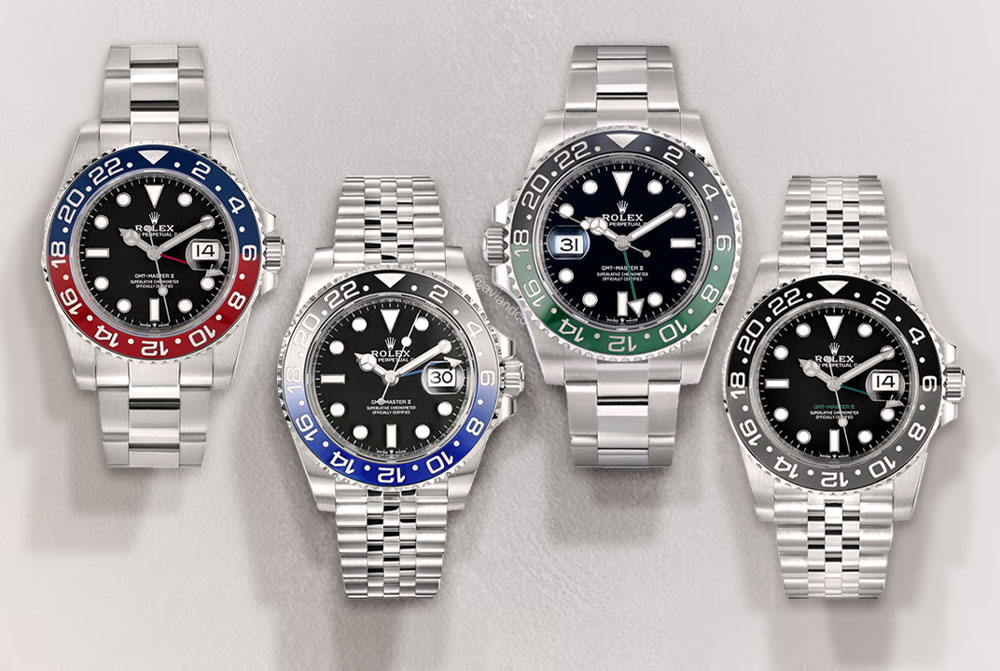
Modern Rolex GMT-Master II Bezel Colors
Rolex GMT-Master II Reference 126710BLRO: Steel "Pepsi"
Introduced in 2018, the 126710BLRO brought the red-and-blue Cerachrom bezel to an Oystersteel GMT-Master II. The watch initially appeared on a Jubilee bracelet, creating a combination that immediately distinguished it from the earlier white-gold 116719BLRO.
For many enthusiasts, the 126710BLRO represents the modern interpretation of the archetypal GMT aesthetic: steel construction, a red-and-blue 24-hour bezel, and a direct visual connection to decades of Rolex travel-watch history. Later availability on an Oyster bracelet broadened the configuration choices.
Rolex GMT-Master II Reference 126710BLNR: “Batman” and “Batgirl”
The Reference 126710BLNR continued the blue-and-black GMT-Master II into the Calibre 3285 generation. When paired with the Oyster bracelet, collectors generally continue to call the watch “Batman.” The Jubilee-bracelet configuration has acquired the unofficial nickname “Batgirl.”
These names are entirely collector-created. Rolex identifies its watches by their reference numbers rather than superhero nicknames. This distinction is worth making because the watch itself remains a 126710BLNR regardless of which bracelet it is fitted with.
Rolex GMT-Master II Reference 126711CHNR: Two-Tone “Root Beer”
The Reference 126711CHNR combines Oystersteel and Everose gold with a brown-and-black Cerachrom bezel. The suffix CHNR refers to the brown-and-black color combination, while collectors commonly associate the watch with the historic “Root Beer” nickname.
Its warm bezel tones and Everose-gold center links give the 126711CHNR a markedly different personality from the cooler steel GMTs. Although modern CHNR watches are commonly called “Root Beer,” collectors should recognize that the nickname predates this reference and has also been applied to earlier brown-toned configurations.
Rolex GMT-Master II Reference 126715CHNR: Everose-Gold “Root Beer”
The Reference 126715CHNR takes the same brown-and-black ceramic concept into a full 18K rose gold case and bracelet. Rolex identifies the reference as an Everose gold GMT-Master II introduced with the brown-and-black Cerachrom insert in 2018.
The full-gold construction transforms the GMT-Master II from its professional-watch roots into a more luxurious travel watch while retaining exactly the same fundamental GMT functionality.
Rolex GMT-Master II Reference 126719BLRO: White-Gold Pepsi
The Reference 126719BLRO continues the red-and-blue bezel tradition in prestigious 18K white gold. Because white gold can resemble stainless steel from a distance, the reference offers a relatively discreet precious-metal interpretation of the Pepsi design.
Certain dial configurations have become particularly recognizable, including versions with blue dials and meteorite dials. The latter combines the familiar GMT architecture with a naturally patterned material, creating one of the most distinctive precious-metal GMT-Master II watches.
Rolex GMT-Master II Reference 126720VTNR: The Left-Handed "Sprite"
One of the most unconventional GMT-Master IIs arrived in 2022 with the dawn of the Reference 126720VTNR. This variation introduced a green-and-black Cerachrom bezel and, more dramatically, moved the winding crown and crown guard to the left side of the case. The date aperture and Cyclops lens were also repositioned to 9 o’clock.
The suffix VTNR refers to vert/noir (green and black). Collectors rapidly nicknamed the watch the “Sprite,” aligning with the rest of the soda-themed nicknames for this collection. The 126720VTNR is available with both Oyster and Jubilee bracelets and remains mechanically recognizable as a GMT-Master II despite its reversed visual architecture.
Rolex GMT-Master II Reference 126718GRNR: Yellow Gold and Grey/Black
Rolex expanded the modern collection again in 2023 with the Reference 126718GRNR. This model pairs 18 ct yellow gold with a two-color grey-and-black Cerachrom bezel. The suffix GRNR refers to gris/noir (grey and black). This bezel combination has been nicknamed the “Bruce Wayne,” an allusion to the alter ego of Batman.
Its introduction was also notable for the return of the Jubilee bracelet to a full yellow-gold GMT-Master II, producing an aesthetic that deliberately connects contemporary GMT technology with Rolex design cues from earlier decades. A yellow Rolesor counterpart, Reference 126713GRNR, brought the same bezel combination to steel and yellow gold.
Rolex GMT-Master II Reference 126710GRNR: Steel Grey/Black GMT
In 2024, Rolex introduced the Reference 126710GRNR, bringing the grey-and-black Cerachrom bezel to Oystersteel. The watch pairs its understated bezel with a green GMT hand and green "GMT-Master II" dial text, providing subtle color against the otherwise monochromatic steel, black, and grey appearance.
As with other contemporary steel GMT-Master II references, bracelet configuration can substantially change the watch’s character while leaving the underlying reference unchanged.
What Do Rolex GMT-Master II Reference Suffixes Mean?
Modern GMT-Master II reference suffixes provide useful clues about bezel color. Here is a breakdown of what you can infer from a reference suffix.
| Suffix | Meaning | Bezel Colors | Common Nickname |
| LN | Lunette Noire | Black | — |
| BLNR | Bleu/Noir | Blue/Black | Batman / Batgirl |
| BLRO | Bleu/Rouge | Blue/Red | Pepsi |
| CHNR | Chocolat/Noir | Brown/Black | Root Beer |
| VTNR | Vert/Noir | Green/Black | Sprite |
| GRNR | Gris/Noir | Grey/Black | Bruce Wayne |
Collector nicknames are useful shorthand, but they should not be confused with official Rolex model names. A “Batman,” for example, is fundamentally a blue-and-black GMT-Master II identified through the BLNR suffix.
Major Rolex GMT-Master II References at a Glance
There are many different Rolex GMT-Master II references to keep track of. Here is a quick guide to help you stay apprised of which references might top your wish list.
| Reference | Era | Material | Bezel | Why It Matters |
| 16760 | 1983–1988 | Steel | Burgundy/black aluminum | First GMT-Master II |
| 16710 | 1989–2007 | Steel | Pepsi, Coke or black aluminum | Defining five-digit GMT-Master II |
| 16713 | 1989–2007 | Steel/yellow gold | Multiple (aluminum) | Two-tone GMT-Master II |
| 16718 | 1989–2007 | Yellow gold | Multiple (aluminum) | Gold GMT-Master II |
| 116718LN | 2005–2019 | Yellow gold | Black ceramic | Began ceramic era |
| 116710LN | 2005–2019 | Steel | Black ceramic | Defining early modern steel GMT |
| 116710BLNR | 2013–2019 | Steel | Blue/black ceramic | First two-color Cerachrom bezel |
| 116719BLRO | 2014–2019 | White gold | Red/blue ceramic | First ceramic Pepsi |
| 126710BLRO | 2018–2026 | Steel | Red/blue ceramic | Modern steel Pepsi |
| 126710BLNR | 2019–Present | Steel | Blue/black ceramic | Current-generation Batman/Batgirl |
| 126711CHNR | 2018–Present | Steel/Everose | Brown/black ceramic | Modern two-tone Root Beer |
| 126715CHNR | 2018–Present | Everose gold | Brown/black ceramic | Full-gold modern Root Beer |
| 126719BLRO | 2018–2026 | White gold | Red/blue ceramic | Precious-metal Pepsi |
| 126720VTNR | 2022–Present | Steel | Green/black ceramic | Left-crown “Sprite” |
| 126718GRNR | 2023–Present | Yellow gold | Grey/black ceramic | Modern yellow-gold GRNR |
| 126713GRNR | 2023–Present | Steel/yellow gold | Grey/black ceramic | Yellow Rolesor GRNR |
| 126710GRNR | 2024–Present | Steel | Grey/black ceramic | Steel grey/black GMT |
The GMT-Master II Family Tree
For collectors trying to understand the collection at a glance, the evolution can be simplified into three principal eras:
- Original GMT-Master II: 16760
- Five-Digit/Aluminum Era: 16710 (stainless steel), 16713 (two-tone gold and stainless steel), and 16718 (yellow gold)
- Six-Digit Ceramic Era: All references beginning with 1167XX
- Modern Generation: All references beginning with 1267XX
Within the current generation, the suffix increasingly tells the story: BLRO for red/blue, BLNR for blue/black, CHNR for brown/black, VTNR for green/black, and GRNR for grey/black.
Understanding those generations is more useful than memorizing every GMT-Master II ever produced. The 16760 established the complication, the 16710 defined the classic aluminum-bezel era, the 1167XX references transformed the watch through ceramic technology, and the 1267XX generation combined that modern construction with Calibre 3285 and an increasingly diverse selection of historically inspired and contemporary color combinations.
Evolution and Production Timeline of the Rolex GMT-Master II
Since the first GMT-Master II appeared in 1982, Rolex has preserved the collection’s essential purpose (a professional travel watch capable of displaying multiple time zones) while continually improving its movements, materials, bezel technology, bracelets, and overall construction.
Understanding this evolution is easiest by dividing the GMT-Master II into several major generations. We have outlined them above, but will walk through them here together.
1982–1988: The Reference 16760 Establishes the GMT-Master II
The GMT-Master II debuted in 1982 with Reference 16760, introducing the feature that separated the new collection from the original GMT-Master: an independently adjustable local hour hand.
Powered by Calibre 3085, the 16760 allowed the conventional hour hand to move forward or backward in one-hour increments without disturbing the minutes, seconds, or 24-hour reference-time display. This made changing local time considerably easier for travelers.
The reference also introduced a burgundy-and-black aluminum bezel and a thicker case that eventually inspired the collector nickname “Fat Lady.” Although relatively short-lived, the 16760 established the mechanical architecture that continues to define the GMT-Master II.
1989–2007: The Reference 16710 Era
Around 1989, Rolex introduced the slimmer Reference 16710, beginning one of the longest and most important periods in GMT-Master II history.
The 16710 was available with red-and-blue “Pepsi,” red-and-black “Coke,” and all-black aluminum bezel inserts. During its lengthy production run, Rolex also updated the luminous material, bracelet, dial details, case construction, and movement. Most examples use Calibre 3185, while certain late-production watches received Calibre 3186.
Importantly, the GMT-Master II did not immediately replace the original GMT-Master. Rolex continued producing both collections simultaneously until 2000, when the original GMT-Master was discontinued and the GMT-Master II became the sole continuation of Rolex’s pilot’s watch.
2005–2012: The Dawn of the Ceramic Bezel in the GMT-Master II
A major transformation began in 2005 with the yellow-gold Reference 116718LN, which introduced a black ceramic bezel insert to the GMT-Master II. The ceramic material Rolex would call Cerachrom offered greater resistance to scratches, corrosion, and ultraviolet light than traditional aluminum inserts.
The six-digit generation also introduced a more substantial case appearance, larger hour markers, upgraded bracelets and clasps, and other refinements. Stainless steel Reference 116710LN subsequently brought this modern design language to the steel GMT-Master II.
2013–2017: Two-Color Ceramic Bezel Technology
In 2013, Rolex achieved an important technical milestone with the 116710BLNR, featuring a single-piece Cerachrom insert in blue and black. It was Rolex’s first two-color ceramic bezel and became known among collectors as the “Batman.”
One year later, the 116719BLRO brought the historically important red-and-blue "Pepsi" color combination into the ceramic era, initially in 18 ct white gold. These developments demonstrated that Rolex could reproduce the GMT-Master’s signature day/night color combinations using ceramic rather than aluminum.
2018–2021: Calibre 3285 and the Modern Generation
The GMT-Master II entered another generation in 2018 with the introduction of Calibre 3285, offering approximately 70 hours of power reserve. That year, Rolex also introduced the Oystersteel 126710BLRO, returning the red-and-blue bezel to a steel GMT-Master II, initially paired with a Jubilee bracelet.
Rolex simultaneously introduced the 126711CHNR and 126715CHNR, combining brown-and-black Cerachrom bezels with Everose Rolesor and full Everose gold respectively. These models became widely associated with the historic "Root Beer" nickname. The modern 126710BLNR followed, continuing the blue-and-black bezel into the Calibre 3285 generation.
2022–Present: New Colors and Configurations
In 2022, Rolex introduced one of the most unconventional GMT-Master II references ever produced: the 126720VTNR. Its green-and-black Cerachrom bezel was accompanied by a winding crown positioned on the left side of the case and a date aperture at 9 o’clock. Collectors quickly nicknamed the configuration the “Sprite.”
In 2023, Rolex expanded the collection with grey-and-black GRNR bezels on the yellow-gold 126718GRNR and two-tone 126713GRNR. The following year, the 126710GRNR brought the grey-and-black bezel to Oystersteel, continuing Rolex’s strategy of expanding the GMT-Master II through new color and bracelet combinations while preserving the core functionality.
Rolex GMT-Master II Production Timeline
Explore this overview of the production timelines of various Rolex GMT-Master II watches.
| Year | GMT-Master II Milestone | Why It Matters |
| 1982 | Reference 16760 introduced | First GMT-Master II; introduced independently adjustable local hour hand |
| 1989 | Reference 16710 arrived | Established the classic, slimmer five-digit GMT-Master II generation |
| 2000 | Original GMT-Master discontinued | GMT-Master II became the sole continuation of Rolex’s GMT collection |
| 2005 | Reference 116718LN introduced | Began the ceramic-bezel GMT-Master II era |
| 2007 | Reference 16710 era ended | Marked the end of the classic aluminum-bezel steel GMT-Master II |
| 2013 | Reference 116710BLNR introduced | First two-color Cerachrom bezel: blue and black |
| 2014 | Reference 116719BLRO introduced | Red-and-blue "Pepsi" bezel returned in ceramic, initially in white gold |
| 2018 | Reference 126710BLRO introduced | Steel ceramic Pepsi returned with new-generation Calibre 3285 |
| 2018 | References 126711CHNR and 126715CHNR debuted | Introduced modern brown-and-black "Root Beer" configurations |
| 2019 | Reference 126710BLNR generation arrived | Blue-and-black GMT moved to Calibre 3285 generation |
| 2022 | Reference 126720VTNR introduced | First modern left-crown GMT-Master II with green-and-black bezel |
| 2023 | 126718GRNR and 126713GRNR introduced | Grey-and-black bezel arrived in yellow gold and yellow Rolesor |
| 2024 | Reference 126710GRNR introduced | Grey-and-black Cerachrom bezel came to Oystersteel |
Over more than four decades, the GMT-Master II has evolved from the relatively specialized Reference 16760 into a diverse collection spanning Oystersteel, Rolesor, and precious metals. Aluminum bezels became ceramic, movements progressed from Calibre 3085 to today’s Calibre 3285, and bracelet and bezel options expanded considerably.
Even with those changes, the defining feature introduced with the original GMT-Master II remains unchanged: the independently adjustable local hour hand working alongside a 24-hour reference-time display. That continuity is what connects every GMT-Master II, from the 16760 “Fat Lady” to the latest ceramic-bezel references.
Movements, Complications & Technical Guide
The Rolex GMT-Master II was designed around one primary complication: displaying multiple time zones in a practical format for international travelers. While its dial may appear relatively straightforward, the movement architecture behind the watch allows the wearer to adjust local time independently, preserve a separate reference time, and even calculate a third time zone using the rotating bezel.
Since the GMT-Master II debuted in 1982, Rolex has continually refined this system through several generations of automatic movements. The progression from Calibre 3085 to 3185, 3186, and ultimately 3285 reflects broader improvements in efficiency, reliability, shock resistance, precision, and power reserve.
How Does the GMT-Master II Work?
The defining feature of the GMT-Master II is its independently adjustable conventional hour hand. The standard hour, minute, and seconds hands display local time. A separate arrow tipped hand circles the dial once every 24 hours and indicates reference time against the graduated 24-hour bezel.
When traveling to another time zone, the wearer can move the conventional hour hand forward or backward in one-hour increments without stopping the watch or changing the position of the minute, seconds, or 24-hour hands.
The date is linked to local time, meaning it moves forward or backward as the local hour hand crosses midnight. With the bezel in its standard position, the watch simultaneously displays:
- Local time using the conventional hour and minute hands
- Reference or home time using the 24-hour hand and bezel
The bidirectional bezel provides an additional capability. By rotating the 24-hour scale relative to the 24-hour hand, the wearer can calculate a third time zone, although doing so temporarily replaces the bezel’s normal reference-time indication.
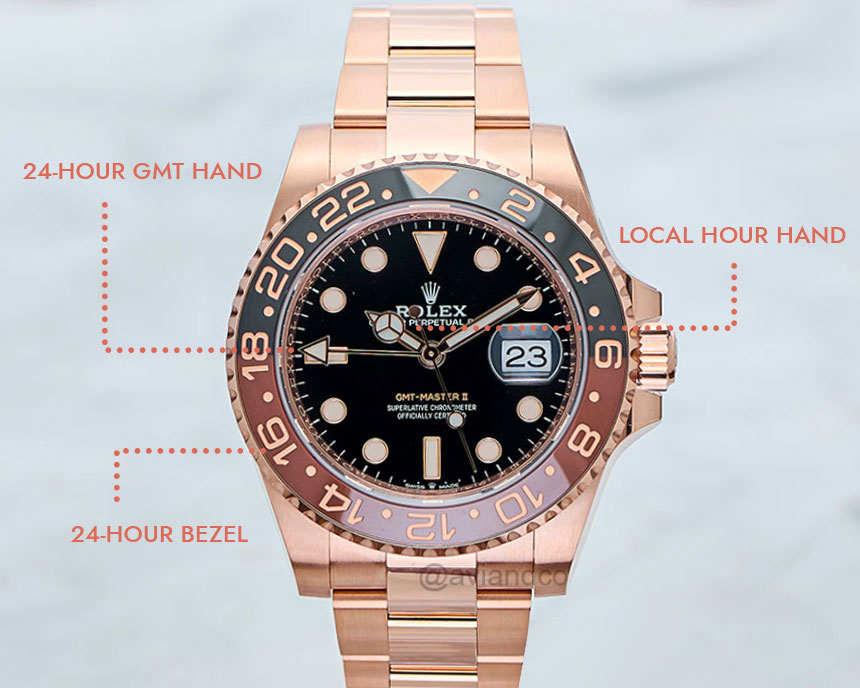
How the Rolex GMT-Master II Displays Multiple Time Zones
Calibre 3085: The Movement That Created the GMT-Master II
The GMT-Master II line began with Calibre 3085, introduced in 1982. Its critical innovation was the ability to adjust the conventional hour hand independently of the other hands. Previous GMT-Master movements linked the conventional and 24-hour displays, meaning they could not be adjusted independently in the same way.
The arrival of Calibre 3085 was significant enough that Rolex created a new model name for watches using the functionality: the GMT-Master II, of course.
Calibre 3085 powered the inaugural Reference 16760. The movement’s architecture contributed to the reference’s comparatively thick case, one of the visual characteristics distinguishing the first GMT-Master II from later generations.
Calibre 3185: The 16710 Generation
The next major movement was Calibre 3185, most closely associated with the long-running Reference 16710. Calibre 3185 retained the GMT-Master II’s independent local-hour adjustment while allowing Rolex to produce a slimmer watch than the 16760.
For much of the 16710’s production life, Calibre 3185 served as the mechanical foundation of the collection. Its longevity helped establish the functionality collectors now expect from a Rolex GMT. Because the 16710 remained in production for many years, movement type can also help distinguish different production periods within the same reference.
Calibre 3186: The Final Evolution Before 3285
Rolex introduced Calibre 3186 during the mid-2000s as the successor to Calibre 3185. The movement appeared in six-digit GMT-Master II references and can also be found in certain late-production 16710 watches, making those examples particularly interesting to collectors.
Calibre 3186 incorporated Rolex’s blue Parachrom hairspring, providing improved resistance to magnetic fields, temperature variations, and shocks. It maintained the familiar GMT-Master II architecture: conventional local time, independently adjustable local hour hand, 24-hour reference-time display, and date. The movement remained central to the GMT-Master II until Rolex introduced an entirely new generation in 2018.
Calibre 3285: The Modern GMT-Master II Movement
Introduced into the GMT-Master II in 2018, Calibre 3285 powers the current generation of the collection. Entirely developed and manufactured by Rolex, the selfwinding movement retains the complication established by Calibre 3085 while introducing substantial technical improvements.
One of the most important is the Chronergy escapement. Made from nickel-phosphorus, it combines improved energy efficiency with resistance to magnetic fields. Calibre 3285 also uses Rolex’s paramagnetic blue Parachrom hairspring and high-performance Paraflex shock absorbers, helping the movement maintain stability when exposed to temperature changes, magnetism, and physical shocks.
Improved escapement efficiency and barrel architecture contribute to an approximately 70-hour power reserve, meaning a fully wound GMT-Master II can generally be removed for a weekend and still be running when worn again. Current GMT-Master II models are certified as Superlative Chronometers, with Rolex specifying precision of −2/+2 seconds per day after casing.
The 24-Hour Bezel and Cerachrom Insert
The bidirectional 24-hour bezel is an integral part of the GMT-Master II’s functionality rather than simply a decorative feature. Early GMT-Master II references used aluminum bezel inserts. These were lightweight and colorful but could scratch and fade with use and exposure.
Beginning in 2005, Rolex transitioned the collection toward ceramic. Modern Cerachrom inserts are manufactured from high-technology ceramic that Rolex describes as extremely hard, virtually scratchproof, corrosion resistant, and unaffected by ultraviolet light.
Producing two-color ceramic inserts presented an additional technical challenge. Rolex introduced its first two-color Cerachrom GMT bezel in blue/black in 2013, followed by red/blue in 2014. Modern variations include brown/black, green/black, and grey/black. The 24-hour numerals and graduations are molded into the ceramic and coated with precious metal.
Oyster Case and Water Resistance
Modern GMT-Master II watches use a 40 mm Oyster case constructed around a monobloc middle case, screw-down caseback, and screw-down winding crown. The Triplock winding crown incorporates a triple waterproofness system and screws securely against the case. Current GMT-Master II models are rated to 100 meters (330 feet) of water resistance.
A scratch-resistant sapphire crystal protects the dial, while the characteristic Cyclops lens magnifies the date display. These features reinforce the GMT-Master II’s origins as a professional tool watch despite its modern status as a luxury travel watch.
Oyster and Jubilee Bracelets
The GMT-Master II has been offered with both Oyster and Jubilee bracelets, particularly in modern generations. The Oyster bracelet uses broad three-piece links and provides a sportier, utilitarian appearance. The five-link Jubilee bracelet creates a more intricate, flexible profile.
Modern examples incorporate an Oysterlock safety clasp and the Easylink comfort extension, which allows the wearer to increase the bracelet length by approximately 5 mm without tools.
Bracelet choice does not change the underlying GMT functionality, but it has become an important consideration for collectors. This is particularly important for references such as the BLNR, where enthusiasts commonly differentiate between the Oyster-bracelet “Batman” and Jubilee-bracelet “Batgirl” configurations.
Major Rolex GMT-Master II Movements at a Glance
Use this table to keep track of the major Rolex GMT-Master II movements with ease.
| Calibre | Era | Major References | Significance |
| 3085 | 1982–1989 | 16760 | Introduced independent local-hour adjustment and created the GMT-Master II |
| 3185 | 1988–2006 | 16710 and related references | Long-running movement of the classic aluminum-bezel generation |
| 3186 | 2005–2019 | Late 16710 and early six-digit references | Updated generation incorporating blue Parachrom hairspring |
| 3285 | 2018–Present | 126710, 126711, 126715, 126719, 126720 and other modern references | Current-generation movement with Chronergy escapement and 70-hour power reserve |
GMT-Master II Technical Specifications at a Glance
Here are some of the key technical specifications you will find in the current generation of Rolex GMT-Master II watches, specifically the 1276XX references.
| Feature | Modern GMT-Master II Specification |
| Movement | Rolex Calibre 3285 |
| Movement Type | Automatic mechanical |
| Primary Complication | GMT / multiple time-zone display |
| Local Hour Hand | Independently adjustable in one-hour increments |
| 24-Hour Hand | Displays reference time |
| Third Time Zone | Possible using rotating 24-hour bezel |
| Date | Instantaneous and synchronized with local time |
| Power Reserve | Approximately 70 hours |
| Precision | −2/+2 seconds per day after casing (Superlative Chronometer rating) |
| Escapement | Chronergy |
| Hairspring | Blue Parachrom |
| Shock Protection | Paraflex |
| Case Diameter | 40 mm |
| Bezel | Bidirectional, 24-hour graduated |
| Modern Bezel Material | Cerachrom ceramic |
| Crystal | Scratch-resistant sapphire with Cyclops lens |
| Water Resistance | 100 meters (330 feet) |
| Bracelet Options | Oyster and Jubilee available |
The technical evolution of the GMT-Master II demonstrates Rolex’s preference for refinement rather than reinvention. The complication introduced with Calibre 3085 in 1982 remains fundamentally recognizable in today’s Calibre 3285: Travelers can change local time without stopping the watch or disturbing their reference-time display.
What has evolved is everything supporting that functionality. Modern movements provide greater power reserve, improved resistance to shocks and magnetic fields, and tighter precision standards. Aluminum bezels have given way to durable Cerachrom ceramic, while modern cases, crowns, crystals, bracelets, and clasps provide greater durability and everyday usability.
More than 40 years after the first GMT-Master II, its technical identity remains consistent: a mechanical travel watch designed to make changing time zones as intuitive as possible.
Market Values & Investment Performance
The Rolex GMT-Master II has developed one of the most active secondary markets in modern watch collecting. Its combination of recognizable design, practical functionality, Rolex brand strength, aviation heritage, and numerous collectible variations has helped sustain demand across both current-production and discontinued references.
However, not every GMT-Master II performs equally in the secondary market. Values vary considerably according to reference, bezel configuration, production period, condition, originality, completeness, rarity, and current availability. Certain discontinued watches have become important collectibles, while highly sought-after current references can trade above their official retail prices when availability through authorized retailers is limited.
The GMT-Master II market has also experienced significant volatility. Prices for many luxury sports watches rose sharply during the early 2020s before correcting from their peaks. For collectors, this reinforces an important distinction: Historical significance and long-term collectability should not be confused with guaranteed short-term investment returns.
Why Do Rolex GMT-Master II Watches Hold Their Value?
One of the GMT-Master II’s greatest advantages in the secondary market is its established identity. The collection traces its lineage to the original GMT-Master introduced in 1955 and has maintained essentially the same purpose for decades: allowing travelers to monitor multiple time zones. The GMT-Master II added an independently adjustable local hour hand in the early 1980s, creating the technical architecture that still defines the collection today.
The watch is also highly recognizable. Plus, two-toned bezels have allowed individual references to develop identities of their own.
Discontinuation can further influence collector interest. The 16710 “Coke,” for example, has no direct current-production ceramic equivalent, while the discontinued 116710LN remains distinctive as an all-black ceramic GMT-Master II. Condition and originality are other factors that become increasingly important as references age.
Reference 16760: Collecting the First GMT-Master II
The Reference 16760 “Fat Lady” occupies a particularly important position because it was the first GMT-Master II. Its relatively short production period, Calibre 3085, thicker case, sapphire crystal, and red-and-black “Coke” bezel distinguish it from both earlier and later GMT-Masters.
For collectors, the appeal of the 16760 extends beyond its appearance: It represents the beginning of the GMT-Master II family itself. Recent auction results have reflected the significance of this timepiece, with sales exceeding $24,000.
Reference 16710: The Neo-Vintage Favorite
The 16710 is one of the most significant GMT-Master II references for today’s collectors. Produced from 1989 through 2007, it combines relatively slim five-digit Rolex proportions with modern conveniences such as a sapphire crystal and independently adjustable local hour hand. Its three principal bezel configurations (Pepsi, Coke, and all black) also provide collectors with considerable variety.
Current GMT-Master II Retail vs. Secondary-Market Value
Current-production steel GMT-Master II references deserve a different type of analysis. As of 2026, Rolex lists steel GMT-Master II models in the United States between $11,800 and $12,500. Previous metal models retail for more, reaching $57,000.
Actual secondary-market values can differ substantially from retail, particularly for highly sought-after bezel combinations. For instance, the 126710BLRO “Pepsi” has historically attracted especially strong demand, while BLNR and newer GRNR configurations also have active secondary markets.
This points to an important distinction for buyers: Rolex retail price is not necessarily the same as open-market value. A watch purchased through an authorized Rolex retailer may have a lower official price than the amount required to acquire the same reference immediately through the secondary market. Conversely, secondary-market premiums can contract if supply, demand, or broader luxury-watch conditions change. However, long waiting lists for retail Rolex watches often drive collectors to the secondary market instead.
Estimated Rolex GMT-Master II Market Values
The following figures are intended as general editorial estimates only and should not be interpreted as appraisals or guaranteed transaction prices. Actual prices vary by year, condition, bracelet, dial, provenance, accessories, market conditions, and individual seller.
| Reference | Status | Estimated Secondary-Market Range | Collector Demand |
| 16760 “Fat Lady” | Discontinued | $15,000–$30,000+ | Very High |
| 16710 Pepsi | Discontinued | $13,000–$25,000+ | Very High |
| 16710 Coke | Discontinued | $12,000–$22,000+ | Very High |
| 16710 Black | Discontinued | $10,000–$18,000+ | High |
| 16713 | Discontinued | $10,000–$18,000+ | Moderate–High |
| 16718 | Discontinued | $20,000–$35,000+ | High |
| 116710LN | Discontinued | $11,000–$16,000+ | High |
| 116710BLNR | Discontinued | $13,000–$18,000+ | Very High |
| 116719BLRO | Discontinued | $25,000–$40,000+ | High |
| 126710BLRO | Discontinued | $21,000–$35,000+ | Exceptional |
| 126710BLNR | In Production | $15,000–$20,000+ | Very High |
| 126710GRNR | Current | $20,000–$30,000+ | Very High |
| 126720VTNR | Current | $15,000–$20,000+ | Very High |
| 126711CHNR | Current | $18,000–$25,000+ | Very High |
| 126715CHNR | Current | $40,000–$50,000+ | High |
| 126719BLRO | Discontinued | $45,000–$70,000+ | High |
What Determines the Value of a GMT-Master II?
Several factors can materially affect the value of a GMT-Master II watch.
Reference and Configuration: Certain combinations have stronger collector followings than others, while discontinued bezel colors can become particularly desirable.
Condition: Sharp cases, clean bezels, well-preserved bracelets, and attractive original dials generally command greater interest than heavily polished or modified watches.
Originality: Original bezel inserts, dials, hands, bracelets, clasps, and other period-correct components may influence collector value considerably. The 16710 is particularly interesting in this respect because aluminum bezel inserts can fade differently with age. Some collectors actively seek faded inserts, although condition and authenticity must still be carefully evaluated.
Boxes and Papers: Original guarantees, presentation boxes, hang tags, service records, receipts, and other documentation can make an already desirable watch more appealing, particularly when dealing with rare or unusually well-preserved examples.
Which GMT-Master II References Are Most Collectible?
There is no single most collectible GMT-Master II, but several categories stand out. For historical significance, the 16760 is difficult to overlook because it established the GMT-Master II collection.
For neo-vintage versatility, the 16710 remains particularly compelling. Its long production period, three bezel choices, evolving dial details, and late Calibre 3186 examples provide numerous subcategories for collectors to study.
Among modern watches, the 126710BLRO Pepsi has become one of the defining steel GMT-Master II configurations, while discontinued models such as the 116710LN and original 116710BLNR occupy increasingly distinct positions within the collection’s history.
Rare dials, exceptional condition, unusual provenance, transitional features, and complete sets can elevate specific examples beyond the typical value of their reference.
Is a Rolex GMT-Master II a Good Investment?
Certain GMT-Master II references have appreciated substantially over long periods, but no Rolex should be considered a guaranteed investment. Secondary-market prices are influenced by collector demand, economic conditions, production changes, availability, fashion, and broader trends within the luxury-watch market. A reference trading at a large premium today could command a smaller premium in the future.
Collectors may therefore benefit from focusing first on historical significance, condition, originality, desirability, and personal enjoyment. A well-preserved 16760 or 16710 has value beyond its current market price because it represents an important period in Rolex history. Likewise, modern references such as the 126710BLRO combine contemporary watchmaking with one of the most recognizable designs in the Rolex catalog.
That combination of functionality, history, visual identity, and a deep international collector base has helped make the GMT-Master II one of the most closely followed Rolex sports watches on the secondary market.
Rolex GMT-Master II Buying Guide
Choosing the right Rolex GMT-Master II depends on your preferred era, bezel color, bracelet, material, budget, and collecting goals. While every GMT-Master II shares the same fundamental travel-watch concept, a Reference 16710 from the 1990s offers a very different ownership experience from a current ceramic-bezel 126710.
For first-time buyers, the most useful approach is to decide whether you prefer the slimmer proportions and aluminum bezels of the older GMT-Master II or the more substantial construction, ceramic bezel, and modern movement technology of today’s collection.
Best GMT-Master II for First-Time Buyers: Reference 126710BLNR
For buyers seeking a versatile modern GMT-Master II, the 126710BLNR is an excellent starting point. Its blue-and-black Cerachrom bezel is distinctive without being overly colorful, while Calibre 3285 provides approximately 70 hours of power reserve.
The reference is available with both Oyster and Jubilee bracelets, allowing buyers to choose between a sportier or more traditional Rolex aesthetic. Collectors commonly nickname the Oyster configuration “Batman” and the Jubilee version “Batgirl.”
Best GMT-Master II for Traditionalists: Reference 126710BLRO
For buyers who want the modern watch most closely associated with the GMT collection’s historic color scheme, consider the 126710BLRO “Pepsi.”
Its red-and-blue bezel recalls GMT-Master watches dating back to the 1950s while providing modern Cerachrom construction, Calibre 3285, and contemporary bracelet technology. For many collectors, the BLRO reference suffix represents the quintessential GMT aesthetic.
Best Neo-Vintage GMT-Master II: Reference 16710
Collectors who prefer slimmer cases and traditional aluminum bezel inserts should consider the Reference 16710. Produced for nearly two decades, the 16710 was available with Pepsi, Coke, and all-black bezels. Its relatively restrained proportions give it a distinctly different wrist presence from modern six-digit references.
Individual examples vary significantly by production period. Buyers should consider movement, luminous material, lug configuration, bracelet, bezel insert, dial, and overall originality when comparing watches.
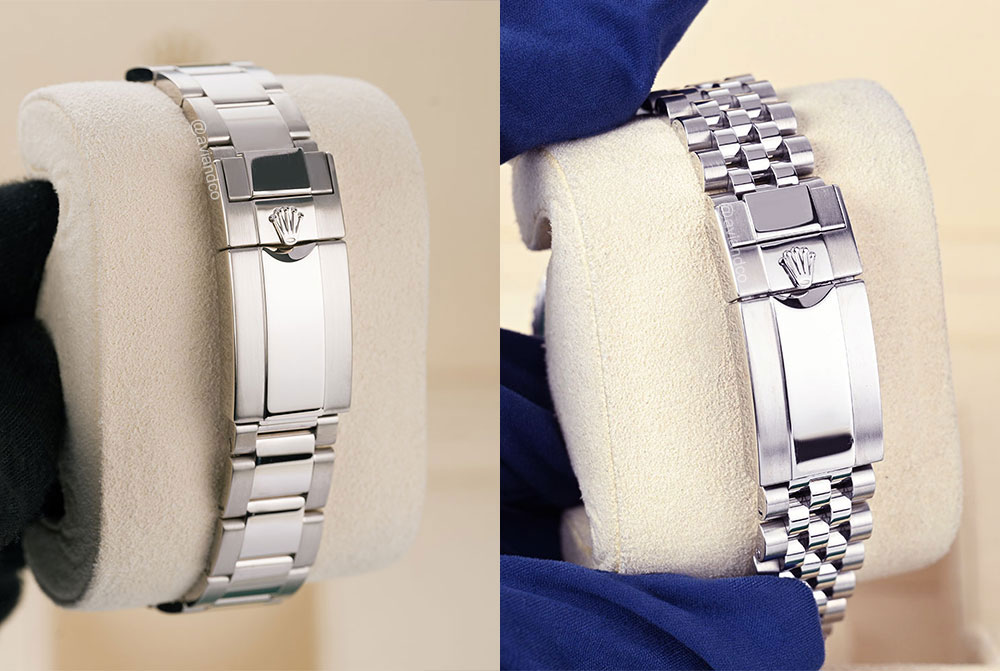
Rolex GMT-Master II Oyster vs. Jubilee Bracelet
Best Historically Significant GMT-Master II: Reference 16760
For collectors prioritizing history, the Reference 16760 is especially compelling because it was the first GMT-Master II. Its thicker “Fat Lady” case, Calibre 3085, and burgundy-and-black bezel distinguish it from later references. Because production was relatively short, finding a strong example may require more patience than buying a 16710 or modern GMT. Condition and originality should be major considerations.
Best Two-Tone GMT-Master II: Reference 126711CHNR
The 126711CHNR, commonly called the modern "Root Beer," combines Oystersteel and Everose gold with a brown-and-black Cerachrom bezel. It offers the same modern GMT functionality as the steel references but with a warmer and more luxurious appearance. For buyers who find full precious-metal models too formal (or steel models too understated) the CHNR occupies an attractive middle ground.
Best Unconventional GMT-Master II: Reference 126720VTNR
The 126720VTNR “Sprite” stands apart from virtually every other GMT-Master II. Its crown is positioned on the left side of the case, while the date and Cyclops lens appear at 9 o’clock. A green-and-black Cerachrom bezel further differentiates the watch. For collectors who want a GMT-Master II that departs significantly from the collection’s traditional layout, the VTNR is one of the most distinctive choices.
Aluminum vs. Ceramic GMT-Master II
One of the biggest decisions is choosing between the aluminum-bezel and ceramic-bezel generations. Five-digit watches such as the 16710 generally offer slimmer cases, lighter-feeling bracelets, and aluminum inserts that may fade and develop character with age. Modern six-digit references offer highly scratch-resistant Cerachrom bezels, more substantial bracelets and clasps, newer movements, and a heavier, more contemporary wrist presence.
Neither is inherently better. The choice depends on whether you prioritize vintage character or modern durability.
What Should You Check Before Buying a GMT-Master II?
For any pre-owned GMT-Master II, verify the reference number, serial information, movement, dial, bezel insert, bracelet, clasp, case condition, service history, and accompanying documentation.
For older references, originality deserves particular attention. Replacement dials, hands, bezel inserts, bracelets, and other service components may affect collector value even when they are genuine Rolex parts. Case condition is also important. Excessive polishing can soften the original case geometry, while heavily stretched bracelets may require repair or replacement.
Finally, buyers should consider provenance and authenticity. Because Rolex GMT-Master II watches are highly valuable and widely replicated, purchasing from an established dealer that can authenticate and assess the condition of the watch provides important additional assurance.
Which Rolex GMT-Master II Should You Buy?
| If You’re Looking For... | Reference to Consider | Why |
| First GMT-Master II | 126710BLNR | Versatile modern steel GMT with Calibre 3285 |
| Classic GMT Look | 126710BLRO | Modern interpretation of the historic red-and-blue bezel |
| Neo-Vintage Rolex | 16710 | Slim case and aluminum bezel with multiple configurations |
| Historical Significance | 16760 | The original GMT-Master II |
| Coke Bezel | 16710 / 16760 | Classic red-and-black aluminum configuration |
| Understated Ceramic GMT | 116710LN | Discontinued all-black ceramic bezel |
| Two-Tone GMT | 126711CHNR | Everose Rolesor and brown/black ceramic |
| Unconventional Modern GMT | 126720VTNR | Left-side crown and green/black bezel |
| Precious-Metal Pepsi | 126719BLRO | White-gold construction with red/blue bezel |
The best GMT-Master II is ultimately the reference that matches how you intend to wear and collect it. The 16710 offers classic neo-vintage character, the 126710BLRO and BLNR provide modern interpretations of Rolex’s most recognizable GMT designs, and the 16760 delivers unmatched significance as the watch that began the GMT-Master II lineage.
Understanding those differences before buying is far more important than simply choosing whichever GMT-Master II currently commands the highest secondary-market premium.
Find Your Rolex GMT-Master II at Avi & Co.
Whether you’re searching for a modern “Pepsi,” “Batman,” or “Root Beer” or a discontinued GMT-Master II from an earlier generation, Avi & Co. offers a carefully curated selection of Rolex watches for collectors and enthusiasts. With decades of experience in the luxury watch market, the Avi & Co. team can help you compare references, understand condition and market value, and choose a GMT-Master II that fits your collection and personal style.
In addition to our extensive collection of Rolex watches, we specialize in many other renowned luxury watch brands from around the globe, including Audemars Piguet, Richard Mille, and Patek Philippe. Our three boutiques are also our own Avi & Co. watch lines as well as our decadent Diamonds by Avi & Co. jewelry line, perfect for the sophisticated modern woman.
Make an appointment today to shop with us in person today and discuss your collecting goals.
Frequently Asked Questions About the Rolex GMT-Master II
What is the Rolex GMT-Master II?
The GMT-Master II is Rolex’s professional travel watch, designed to display multiple time zones using an additional 24-hour hand, independently adjustable local hour hand, and rotating 24-hour bezel. It is the natural descendant of the GMT-Master line, launched in the 1950s.
When was the Rolex GMT-Master II introduced?
Rolex introduced the GMT-Master II watch line in 1982. It followed from the original GMT-Master line of the 1950s and is still in production today.
What was the first Rolex GMT-Master II?
The first GMT-Master II was Reference 16760, powered by Calibre 3085. It was nicknamed the “Fat Lady” due to its thick case to accommodate special new complications.
What is the difference between the GMT-Master and GMT-Master II?
The GMT-Master II allows its conventional local hour hand to be adjusted independently. The original GMT-Master did not provide the same independent local-hour functionality. This development made it much easier for travelers to “jump” their watch forward or back an hour without disrupting the overall timekeeping.
When was the original Rolex GMT-Master introduced?
Rolex introduced the original GMT-Master in 1955.
Why was the Rolex GMT-Master created?
The Rolex GMT-Master was developed during the expansion of international commercial aviation to help pilots and travelers monitor time across different time zones. It was used by Pan American Airlines pilots and gained popularity with jet-setting travelers as well.
What does GMT stand for?
GMT stands for Greenwich Mean Time, historically used as a global time reference. It is also the name of a popular Rolex watch, the GMT-Master II.
How many time zones can a GMT-Master II display?
A GMT-Master II can display two time zones simultaneously in its standard configuration and also calculate a third by rotating the 24-hour bezel.
How does the Rolex GMT-Master II work?
The Rolex GMT-Master II uses unique features to display two time zones at once. The conventional hands display local time while the arrow-tipped 24-hour hand indicates reference time against the bezel. The two-tone bezel helps wearers keep track of whether it is day or night in the reference time zone.
Can you change the GMT-Master II hour hand independently?
Yes, you can change the GMT-Master II hour hand independently. The local hour hand can move forward or backward in one-hour increments without stopping the watch or disturbing the reference-time display. This feature is what sets the GMT-Master II apart from its predecessor, the GMT-Master.
What is the Rolex GMT-Master II “Pepsi”?
The “Pepsi” is the collector nickname for Rolex GMT-Master II watches with a red-and-blue bezel, including the popular modern Reference 126710BLRO.
What is the Rolex GMT-Master II “Coke”?
The GMT-Master II “Coke” nickname refers to GMT-Master II models with a red-and-black bezel, most famously References 16760 and 16710.
What is the Rolex GMT-Master II “Batman”?
The GMT-Master II “Batman” commonly refers to GMT-Master II models with a blue-and-black bezel and the reference suffix BLNR, particularly when fitted with an Oyster bracelet.
What is the Rolex GMT-Master II “Batgirl”?
The GMT-Master II “Batgirl” commonly refers to GMT-Master II models with a blue-and-black bezel and the reference suffix BLNR, particularly when fitted with an Jubilee bracelet.
What is the Rolex GMT-Master II “Root Beer”?
The GMT-Master II “Root Beer” commonly refers to GMT-Master II models with a brown-and-black bezel and the reference suffix CHNR, including modern two-tone and yellow gold editions.
What is the Rolex GMT-Master II “Sprite”?
The Rolex GMT-Master II “Sprite” is the nickname for the GMT-Master II watch Reference 126720VTNR, which features a green-and-black bezel, left-side crown, and date at 9 o’clock.
Are Pepsi, Batman, and Sprite official Rolex names?
No, nicknames like Pepsi, Batman, and Sprite are not official Rolex names. These are collector nicknames, often based on the coloring of the watch’s bezel and/or dial.
What does BLRO mean on a Rolex GMT-Master II?
You might see the letters BLRO on the end of a reference number for a GMT-Master II watch. BLRO stands for blue/rouge and identifies GMT-Master II watches with a blue-and-red bezel configuration. These watches are often nicknamed “Pepsi.”
What does BLNR mean on a Rolex GMT-Master II?
You might see the letters BLNR on the end of a reference number for a GMT-Master II watch. BLNR stands for blue/noir and identifies a blue-and-black bezel. These watches are often nicknamed “Batman.”
What does CHNR mean on a Rolex GMT-Master II?
You might see the letters CHNR on the end of a reference number for a GMT-Master II watch. CHNR stands for chocolat/noir and identifies the modern brown-and-black bezel configuration. These watches are often nicknamed “Root Beer.”
What does VTNR mean on a Rolex GMT-Master II?
You might see the letters VTNR on the end of a reference number for a GMT-Master II watch. VTNR stands for vert/noir and identifies the green-and-black bezel configuration. These watches are often nicknamed “Sprite.”
What does GRNR mean on a Rolex GMT-Master II?
You might see the letters GRNR on the end of a reference number for a GMT-Master II watch. GRNR stands for grey/noir and identifies the grey-and-black bezel configuration. These watches are often nicknamed “Bruce Wayne.”
What movement is in the Rolex 16760?
The Rolex GMT-Master II Reference 16760 uses Rolex Calibre 3085
.
What movement is in the Rolex 16710?
Most Rolex GMT-Master II Reference 16710 watches use Calibre 3185, although certain late-production examples contain Calibre 3186.
What movement is in the modern GMT-Master II?
Current GMT-Master II models with reference numbers that follow the 1276XX formula use Rolex Calibre 3285.
What is the GMT-Master II’s power reserve?
Current models in the Rolex GMT-Master II line are powered by the Calibre 3285, which provides approximately 70 hours of power reserve.
How accurate is a modern Rolex GMT-Master II?
Modern Rolex GMT-Master II watches carry Rolex’s Superlative Chronometer certification, specifying approximately −2/+2 seconds per day after casing.
How big is the Rolex GMT-Master II?
Current Rolex GMT-Master II watches have a 40 mm case size.
Is the Rolex GMT-Master II waterproof?
Current Rolex GMT-Master II models are water resistant to 100 meters, which is equivalent to 330 feet.
What is a Cerachrom bezel?
Cerachrom is ceramic material that was patented by Rolex in 2007 and is often used in the watch’s ceramic bezels. It was engineered for high resistance to scratches, corrosion, and ultraviolet light. You will find Cerachrom bezels in Rolex lines like the GMT-Master II, Submariner, Cosmograph Daytona, Deepsea, Sea-Dweller, and Yacht-Master.
When did the GMT-Master II get a ceramic bezel?
The ceramic GMT-Master II era began in 2005 with the yellow-gold Reference 116718LN. It took eight more years, however, for Rolex to adapt its Cerachrom technology to make one-piece bezels with two colors. This would take place in 2013.
What was the first two-color ceramic GMT-Master II?
The Rolex GMT-Master II Reference 116710BLNR, introduced in 2013 with a blue-and-black bezel, was the first two-color Cerachrom GMT-Master II. It marked an important technological achievement for Rolex to adapt this unique technology to accommodate two colors.
What is the difference between the Rolex 16760 and 16710?
The Rolex GMT-Master II Reference 16760 was the first GMT-Master II and has a thicker case. The succeeding Reference 16710 introduced slimmer proportions and additional bezel choices.
What is the difference between the Rolex 16710 and 126710?
The Rolex GMT-Master II Reference 16710 uses an aluminum bezel and older movement architecture, while the 126710 generation uses Cerachrom ceramic bezel inserts and Calibre 3285. Aluminum bezels have been shown to demonstrate wear and tear, including fading, over the years. This can be an important feature for some collectors.
Is the Rolex 16710 collectible?
Yes, the Rolex GMT-Master II 16710 is highly collectible. Its aluminum bezels, relatively slim proportions, long production history, and numerous variations make the 16710 popular among collectors. Its aluminum bezel can fade or show distress over time, which can actually be attractive to collectors as a sign of the watch’s vintage status and history.
Which Rolex GMT-Master II is the most collectible?
The most collectible Rolex GMT-Master II watches include historically significant references such as the 16760 and 16710, along with rare configurations and well-preserved examples.
Does the Rolex GMT-Master II hold its value?
Many Rolex GMT-Master II references have historically demonstrated strong value retention, although secondary-market values fluctuate with supply, condition, configuration, and demand. We always suggest choosing your next luxury watch investment based on what you are excited to wear and enjoy rather than the possibility of a return on investment.
Is a Rolex GMT-Master II a good investment?
Some Rolex GMT-Master II references have appreciated substantially, but no luxury watch offers guaranteed returns. Collectors should consider condition, originality, historical importance, and personal enjoyment alongside potential value retention.
What should I check before buying a used GMT-Master II?
Before buying a used GMT-Master II watch, you should always check the reference, movement, case, bezel, dial, hands, bracelet, clasp, service history, originality, documentation, and overall condition. Make sure you are purchasing a pre-owned Rolex GMT-Master II from a trusted secondary market dealer in order to have the smoothest experience possible.
Which Rolex GMT-Master II should I buy?
Choosing the right Rolex GMT-Master II to buy depends on personal preference. The 16710 appeals to neo-vintage collectors, while modern references such as the 126710BLRO and 126710BLNR offer ceramic bezels, the impressive Calibre 3285, and contemporary Rolex construction.